

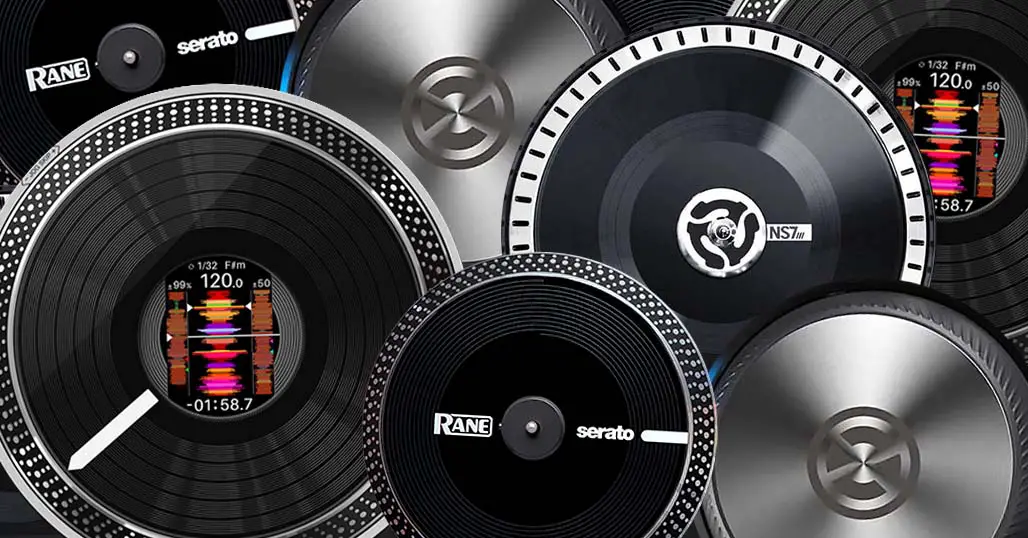
Cutting straight to the chase, I’d get the Rane ONE MKII for a two-deck motorized setup. Its full 7.2-inch control discs sit on proper spindles, the torque and slip can be adjusted, it has a lot of features that scratch DJs will really appreciate, and Serato DJ Pro unlocks when it is connected. It also avoids the extra width and cost of the four-channel Performer.
The other four have more specific jobs. Pick the Rane Performer for four-channel mixing and Stem Split, or the Rane System One when you want to leave the laptop at home. The Pioneer DJ DDJ-REV7 is the current Rekordbox option and uses flat moving tops with screens instead of separate control discs. Finally, the much lighter Hercules DJControl Inpulse T7 covers learning and home use at a considerably lower price.
This guide covers complete controllers and standalone systems that you can still buy new. Individual motorized deck units such as the Rane Twelve are a different kind of setup that are not included here. The older hardware such as the original Rane ONE, Traktor Kontrol S4 MK3, and Numark NS7 while still very capable, make more sense to search for on a used market nowadays, and thus have also not made it into the lineup here.
This web portal is reader-supported and is part of the AliExpress Partner Program, Amazon Services LLC Associates Program, eBay Partner Network, and Guitar Center Affiliate Program. When you buy using links on our site, we may earn an affiliate commission.
How I Constructed This Whole Lineup
The platter construction was one of the most important factors for me here. Spindle and a separate disc vs. a fixed top plate, torque and slip adjustment possibilities (or lack thereof), and the mechanical design of the platters are only a few important things to look at in this comparison.
The faders, mixer channels, source inputs, software, outputs, transport weight, and current manufacturer support also all played an important part in constructing this new ranking. As each pick here solves a different problem, the list is not ordered by price or by the number of controls.
| Controller | Laptop Required | Channels | Platter Setup | Main Software | Weight | Main Limitation |
|---|---|---|---|---|---|---|
| Rane ONE MKII | Yes | 2 | 7.2-inch discs with spindle | Serato DJ Pro | 24.56 lb | Two channels only |
| Rane Performer | Yes | 4 | 7-inch platters with LCDs | Serato DJ Pro | 28.2 lb | Large and expensive |
| Rane System One | No | 2 | 7.2-inch discs with spindle | Engine DJ / Serato | 29.4 lb | No phono or line deck inputs |
| Pioneer DJ DDJ-REV7 | Yes | 2 | 7-inch platters with LCDs | Serato / Rekordbox | 23.6 lb | No center spindle |
| Hercules Inpulse T7 | Yes | 2 | 7-inch records and slipmats | DJUCED / Serato | 11 lb | No booth output or deck inputs |
1. Rane ONE MKII – Best For Most DJs
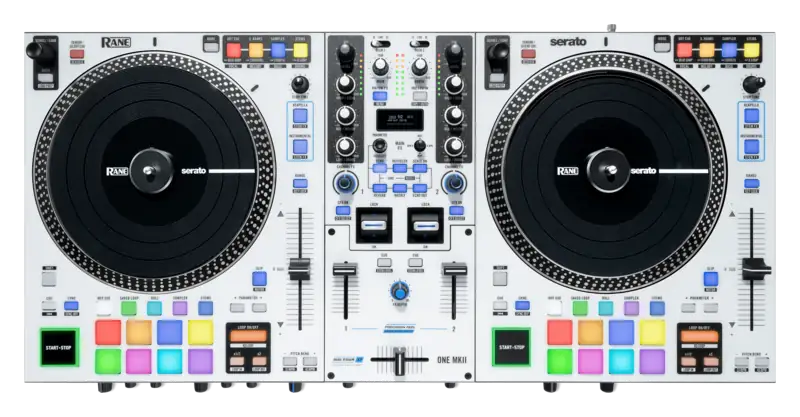
Scratch-focused two-deck controller with full acrylic control discs, selectable torque, washer-adjusted slip, secondary pad triggers, and direct Serato Stems and FX control.
- Torque selection and removable washers give the platters meaningful mechanical adjustment.
- A drilled 7-inch record can replace each stock acrylic control disc.
- The second pad bank keeps another performance mode within reach.
- Track information stays on the laptop because the platters have no displays.
- External sources take over the two mixer channels rather than adding more.
- It weighs 24.56 lb before you add a flight case.
| Type | Two-channel motorized software DJ controller |
| Deck Control | Two decks |
| Platters | 2 x 7.2-inch high-torque motorized platters with acrylic control discs |
| Performance Pads | Eight main pads per deck + four secondary pad controls per deck |
| Software | Serato DJ Pro; VirtualDJ and djay Pro with separate licenses |
| Hardware FX | 29 internal effects with paddle controls |
| External Inputs | 2 x phono/line RCA + 1 x auxiliary RCA |
| Microphone Inputs | 2 x XLR/TRS combo |
| Main Outputs | XLR stereo pair + RCA stereo pair |
| Booth / Zone Output | XLR stereo pair |
| Computer Connections | 2 x USB-B |
| Dimensions | 674.0 x 345.0 x 124.3 mm / 26.5 x 13.6 x 4.9 in |
| Weight | 11.14 kg / 24.56 lb |
What sets the Rane ONE MKII apart from an ordinary two-channel controller is how much of the feel can be set mechanically. The platters are 7.2-inch, traditional center stack. Each acrylic disc locks to a center spindle over an actual felt slipmat. A rear switch can change the motor torque, while picking one or two supplied washers can lift the disc enough to reduce drag and extend the backspin. You can even fit your own drilled 7-inch records with the quick-release adapters if you want to.
The secondary pad group is one of the more useful MKII additions. It can keep Hot Cues, Scratch Bank, Sampler, Stems, Beat Jump, Stem Roll, Stem FX, or Auto Loop ready while the eight lower pads stay in a different mode. This means that you can effectively use two different pad modes at the same time. Instant Acapella and Instrumental buttons, Stem Level EQ, and 29 internal effects complete the image here.
For back-to-back sets, the dual USB ports make computer handovers straightforward. XLR main and booth outputs, two mic inputs, and a pair of switchable phono/line inputs are here as well. Still, keep the one serious limitation in mind, and that is that the ONE MKII is limited to two mixer channels. An external turntable or player needs to occupy one of the existing ones, so there is no way to run four sources together on this controller.
If you normally mix mostly on two decks, I would not pay extra for the Performer just to have a bigger device on hand. If, however, layered Stems, four-deck blends, or two external players are a real part of how you work, the Performer below can be a logical next step from the ONE MK2.
You might also like: Rane FOUR vs. Rane ONE – Gear Comparison
2. Rane Performer – Best Four-Channel Pick
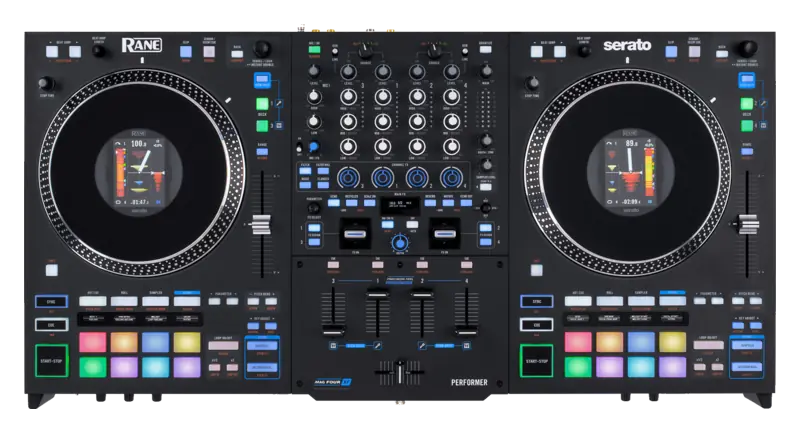
Four-deck Serato controller built around layered 7-inch spinning platters, 3.5-inch displays, Stem Split, adjustable slip rings, and channels 3/4 for external sources.
- Stem Split turns the spare mixer channels into separate vocal and instrumental strips.
- Slip-ring combinations and two torque settings let you tune both decks to taste.
- The platter screens can handle library browsing as well as normal deck data.
- Decks 3 and 4 share the two platters through layer buttons.
- The 30.84-inch width and 28.2 lb weight require deliberate transport planning.
- Using the phono inputs for Serato DVS requires the paid expansion.
| Type | Four-channel motorized software DJ controller |
| Deck Control | Four Serato decks through dual-layer controls |
| Platters | 2 x 7-inch high-torque motorized platters |
| Jog Displays | 2 x 3.5-inch full-color LCD |
| Performance Pads | Eight pads per deck |
| Software | Serato DJ Pro; VirtualDJ with a separate Pro license |
| Hardware FX | 29 internal effects + Serato software effects |
| External Inputs | 2 x phono/line RCA for channels 3 and 4 |
| Microphone Inputs | 2 x XLR/TRS combo |
| Main Outputs | XLR stereo pair + RCA stereo pair |
| Booth / Zone Output | 1/4-inch TRS stereo pair |
| Computer Connections | 2 x USB-B |
| Dimensions | 783.3 x 402.3 x 109.7 mm / 30.84 x 15.84 x 4.32 in |
| Weight | 12.8 kg / 28.2 lb |
So, the Performer earns its extra width when your sets go beyond a normal two-deck mix. Its four-channel mixer can run four Serato decks, but the hardware of course still has only two spinning platters. The left one swaps between decks 1 and 3, and the right between 2 and 4, so you will be working with layers rather than four separate moving surfaces, as per usual on a system like this.
The controller makes use of 7-inch high-torque die-cast aluminum platters with acrylic control discs. The top acrylic plate attaches using four physical touchpoints paired with magnets. It also allows for digital torque adjustment. No height washer tuning here.
Those two extra channel strips, however, are especially useful with Stem Split. Pressing one control can duplicate the track to another deck and separate its vocal from the instrumental, after which each part gets its own fader, EQ, and effects. This is quite a great option to have for live mashups. The same channels can also take a pair of line or phono sources. Serato DVS works here too, although the expansion is not included with the device.
The two 3.5-inch displays in the middle of the platters can show moving waveforms, track information, artwork, or the library, which can potentially cut down how often you need to look back at the laptop. The adjustable Precision Feel channel faders, MAG FOUR crossfader, and 29 internal effects make the mixer section one of the strongest in this group. Serato DJ Pro is included, while VirtualDJ support needs a separate Pro license to run.
3. Rane System One – Best Standalone Pick
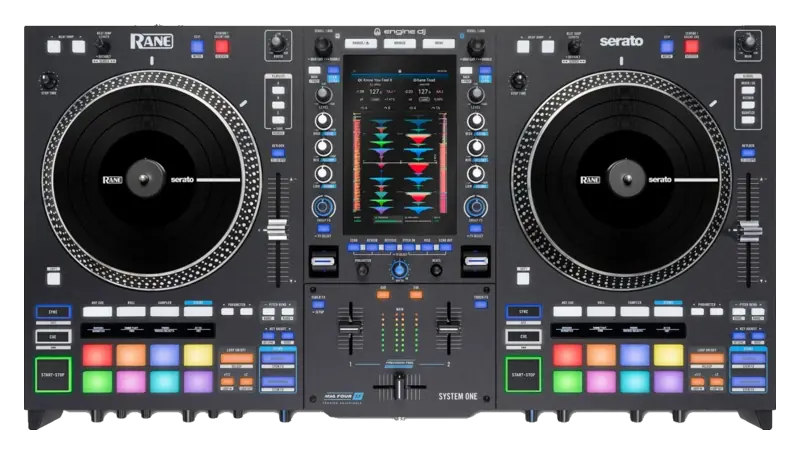
Standalone scratch system combining Rane control discs with Engine DJ library browsing, removable-media playback, on-device Stems rendering, and optional Serato control.
- Engine DJ 5.0 can render four-part Stems on the unit while another track plays.
- USB, SD, streaming, and an internal-drive bay cover several laptop-free library setups.
- Platter friction can be altered with the same simple washer method used on the ONE MKII.
- Turntables and media players cannot be routed through its two mixer channels.
- The 7-inch display is compact for browsing a large standalone library.
- At 29.4 lb before a case, portability is clearly secondary.
| Type | Two-channel motorized standalone DJ system |
| Standalone Decks | Two |
| Platters | 2 x 7.2-inch motorized platters with acrylic control discs |
| Screen | 7-inch HD multi-touch display |
| Software / OS | Engine DJ; Serato DJ Pro 4.0.3 or later |
| Media | 3 x USB-A, USB-C media input, SD card, Wi-Fi streaming, optional internal 2.5-inch SATA drive |
| External Audio Input | 1 x auxiliary RCA + Bluetooth audio |
| Microphone Inputs | 2 x XLR/TRS combo |
| Main Outputs | XLR stereo pair + RCA stereo pair |
| Booth Output | 1/4-inch TRS stereo pair |
| Dimensions | 736.6 x 403.0 x 144.7 mm / 29.0 x 15.87 x 5.70 in |
| Weight | 13.33 kg / 29.4 lb |
The System One, as a standalone device, can load a USB drive and play a normal set with no computer attached, something none of the other four can do. Engine DJ handles the library from its 7-inch touchscreen and reads USB media, SD cards, supported streaming services, or an optional internal SATA drive. Connecting a laptop is still possible when Serato is the better fit for the job.
With Engine DJ 5.0, four-part Stems no longer have to be prepared on a separate machine, which is another boon that comes with this one. The System One can render individual tracks or queued playlists on its own, even with music playing on the other deck. Serato support starts at DJ Pro 4.0.3. Rane has discussed VirtualDJ and djay for a later update, but neither are there yet as of the time of writing this article.
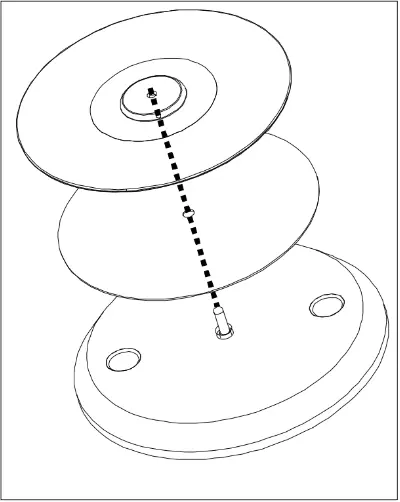
Its 7.2-inch control discs are practically the same design borrowed from the Rane ONE MKII: spindle, slipmat, acrylic disc, and optional spacing washers. Adding a washer lifts the disc slightly, reduces friction, and lengthens the backspin. The adjustment takes seconds and is easy to reverse. Both should be nearly identical in terms of feel.
Sadly, on the System One, neither of the mixer channels can accept a turntable or media player, and the hardware is limited to only the two active decks. The RCA auxiliary input and Bluetooth receiver are fine for a backup source or a request from a phone, but they bypass the kind of full channel control a hybrid setup would call for. The unit also weighs 29.4 lb on its own, which makes it the heaviest device in our lineup. Just another thing to keep in mind.
Get the System One if removing the laptop from your workflow is one of your main goals. If having access to four channels or external deck inputs matters more, the Performer will be much more flexible. For a wider look at current screen-based all-in-one systems, see my guide to the best DJ controllers with built-in screens.
4. Pioneer DJ DDJ-REV7 – Best For Rekordbox
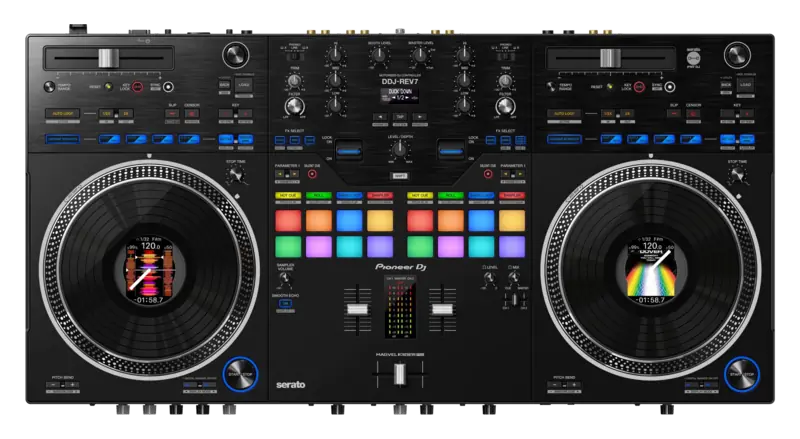
Pioneer DJ’s two-deck scratch controller with flat 7-inch spinning tops, 3.5-inch deck screens, horizontal pitch faders, hardware Beat FX, and Rekordbox/Serato support.
- The platter screens keep deck position and stacked waveforms close to your hands.
- Horizontal pitch faders and central pads closely follow a battle-position setup.
- Its 22 Beat FX and five Sound Color FX are controlled directly from the hardware.
- The fixed top plates cannot reproduce the spindle grip of a separate control disc.
- There is no layer access to Serato decks 3 and 4.
- The horizontal pitch layout takes adjustment if you come from club-style hardware.
| Type | Two-channel motorized software DJ controller |
| Deck Control | Two decks |
| Platters | 2 x 7-inch motorized jog wheels with vinyl-textured acrylic tops |
| Jog Displays | 2 x 3.5-inch LCD |
| Software | Serato DJ Pro + Rekordbox for Mac/Windows |
| Hardware FX | 22 Beat FX + 5 Sound Color FX |
| External Inputs | 2 x phono/line RCA + 1 x auxiliary RCA |
| Microphone Inputs | 1 x XLR/TRS combo + 1 x 1/4-inch TRS |
| Main Outputs | XLR stereo pair + RCA stereo pair |
| Booth Output | 1/4-inch TRS stereo pair |
| Computer Connections | 2 x USB-B |
| Dimensions | 732.0 x 382.2 x 82.4 mm / 28.8 x 15.0 x 3.2 in |
| Weight | 10.7 kg / 23.6 lb |
The Pioneer DDJ-REV7 is the only model in this shortlist with official Rekordbox support. Compatibility was added in 2024, well after the controller launched, and Serato DJ Pro of course remains supported too. That alone gives it a clear place here for DJs who already prepare everything in Rekordbox.
Its two 7-inch jog wheels use vinyl-textured acrylic top plates and adjustable low or high torque via a mechanical switch. There is no center spindle here, as the REV7 makes use of a simple hollow-center stack. In its place, each deck has a 3.5-inch screen that can show waveforms, artwork, playback position, BPM, time, and other useful information, similarly to the Rane Performer. The top discs are attached using magnets.
The battle layout places the pitch faders horizontally at the top and keeps the performance pads in the central mixer section. You also get the MAGVEL FADER PRO crossfader, 22 built-in Beat FX, five Sound Color FX, paddle controls, dual USB connections, and proper main and booth outputs. Instant Scratch can trigger its built-in samples even when no laptop is connected, although the controller itself cannot play full tracks on its own.
Between this and the ONE MKII, I would choose the REV7 for Rekordbox, the on-jog displays, or a strong preference for Pioneer DJ’s battle style scratch layout. The Rane gives you a center spindle, newer Stems controls, and adjustable full-size control discs. My DDJ-REV7 vs Rane ONE comparison goes further into the basic layout and platter differences between this one and the first-generation Rane ONE.
You might also like: What Is A Battle Style DJ Controller Layout? – Quickly Explained
5. Hercules DJControl Inpulse T7 – Best Budget Pick
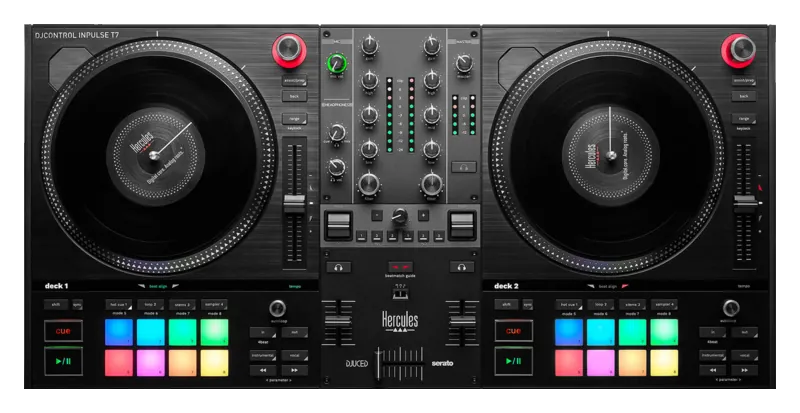
Entry-level two-deck unit using removable vinyl, felt slipmats, and belt-driven metal platters, with long pitch faders, Beatmatch Guide lighting, and DJUCED/Serato support.
- The separate record and slipmat teach useful moving-vinyl hand control.
- Long pitch faders and Beatmatch Guide lights help with learning manual beatmatching.
- Built-in handles make the 11 lb body genuinely easy to carry.
- The belt drive starts quickly but does not have the force of the high-torque models.
- DJUCED and Serato Lite are included; the full Serato package costs extra.
- No booth output or source inputs rules out several professional setups.
| Type | Two-channel motorized software DJ controller |
| Deck Control | Two decks |
| Platters | 2 x 7-inch motorized metal platters with removable vinyl discs and felt slipmats |
| Platter Speed | 33 1/3 RPM; 45 RPM available in Serato DJ Pro |
| Performance Pads | Eight pads per deck |
| Software | DJUCED + Serato DJ Lite; Serato DJ Pro is a paid upgrade |
| External Deck Inputs | None |
| Microphone Input | 1 x balanced 1/4-inch jack |
| Main Outputs | XLR stereo pair + RCA stereo pair |
| Booth Output | None |
| Audio Resolution | 24-bit / 44.1 kHz |
| Dimensions | 652 x 350 x 90 mm / 25.7 x 13.8 x 3.5 in |
| Weight | 5.0 kg / 11 lb |
The Inpulse T7 makes sense when you mainly want to learn on a moving record and cannot justify the price of the premium units. A removable 7-inch vinyl disc and felt slipmat sit over each motorized metal platter, so cueing, nudging, releasing, and basic scratches involve the same kind of hand movement. Hercules quotes a tenth of a second to reach 33 1/3 RPM; Serato DJ Pro also enables 45 RPM. This is the only device on this list that makes use of a belt-drive motor, instead of the more modern direct-drive solution.
DJUCED and Serato DJ Lite work right away with the unit, and the Beatmatch Guide lights are a beginner-friendly addition that shows whether the tempo and phase need correction. That is helpful while learning to match tracks by ear instead of reaching straight for Sync. The full Serato DJ Pro version is compatible but not unlocked by the hardware, so include that license in the real purchase price.
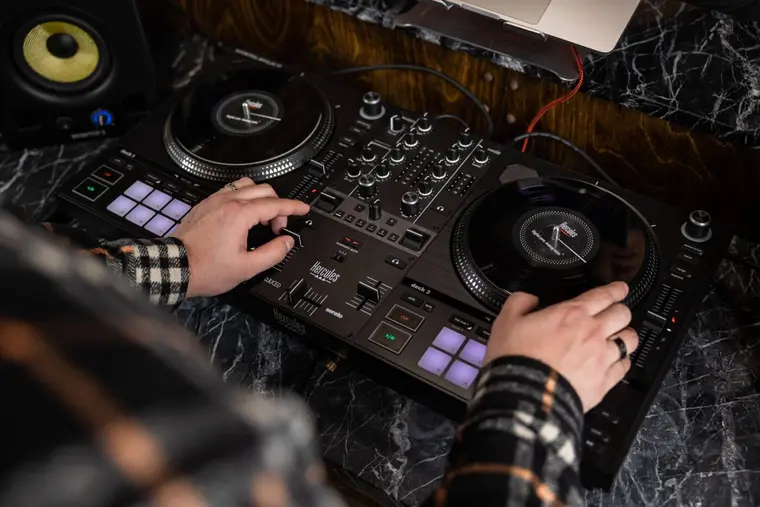
The 11 lb weight and smaller size are two advantages here. It is less than half the weight of every other controller on this list, and the built-in handles make it much easier to move around. Hercules still gives you balanced XLR main outputs and a balanced microphone input, so the smaller size of the unit does not mean you are limited to RCA speakers.
There is no booth output, no external deck input, no second computer connection, and no built-in hardware effects engine. Its belt-driven platters also feel lighter than the high-torque systems on the ONE MKII, Performer, System One, and REV7. It remains a neat first motorized controller, especially for home use and simpler mobile setups. You can read my full Hercules DJControl Inpulse T7 overview for a closer look.
Are DJ Controllers With Motorized Platters Worth It?
While the mixing experience on motorized platters won’t be exactly the same as on a real-deal vinyl turntable set, it can get reasonably close.
The moving surface gives your hands continuous feedback. You can hold the record still while the platter moves below it, release a cue by feel, make small timing corrections on the disc or platter edge, and practice scratch techniques in a way that a static capacitive jog wheel cannot really copy.
At the same time you also get the convenience of digital files, cue points, loops, Stems, and software effects, much like with more expensive and sophisticated DVS setups. All that while skipping thinking about the cartridge setup, needle handling, anti-skate, feedback control, or how imperfect records behave, which are all issues you need to be wary of in traditional vinyl setups.
That, of course, does not mean everyone needs them. Motorized controllers are heavier, more expensive, and mechanically more complex. For conventional house, techno, and club mixing, a good static jog wheel can be every bit as accurate while being easier to maintain.
If you can, try the controller at your local music store before buying it. Torque, platter friction, the presence or absence of a center spindle, and the position of the pitch faders all affect the feel. My DJ jog wheel types guide explains the main mechanical differences in more detail.
What To Look For When Deciding
Two Or Four Channels
Most scratch routines and open-format sets will work perfectly well on two channels. Four channels matter when you layer several tracks, split Stems across mixer channels, or keep external decks connected. The Performer is the only current pick on this list with a four-channel mixer. It still uses two physical platters, so decks 3 and 4 are accessed through layers.
Laptop Or Standalone
The System One is the only device in this guide that can load and play full tracks without a computer. The other four need a laptop and compatible DJ software for normal deck playback.
Software
Serato DJ Pro is the common thread across the premium laptop controllers and is now also supported on the System One. Rekordbox users should look closely at the DDJ-REV7, as it is the only motorized controller here with official Rekordbox support. The T7 includes Serato DJ Lite and DJUCED, while the full version of Serato costs extra. Engine DJ is a separate standalone workflow, even though it can import Serato library data.
Connections
XLR main outputs are present on all five picks. Booth output, external deck inputs, dual-computer handover, and the number of microphone inputs vary much more. The T7, as the budget model, has the leanest connection set, while the Performer, ONE MKII, and REV7 are better prepared for multi-source professional setups.
Weight And Transport
Moving platters and the mechanism add real weight. The Rane System One and Performer are both around 29 lb before you add a case. The ONE MKII and REV7 are a little lighter, but still substantial. The 11 lb Hercules T7 is the clear choice when you carry your own setup often, although some of that saving comes from its lighter construction and simpler connection set.
What About Older Motorized DJ Controllers?
The original Rane ONE can still be an excellent used buy when it is meaningfully cheaper than the MKII and you do not need the newer internal effects and Stems controls. The Traktor Kontrol S4 MK3 is no longer sold new by Native Instruments, but its small Haptic Drive jog wheels can still make sense for committed Traktor users.
Numark’s NS7 II and NS7 III are much older devices and need a more careful check of the platter mechanisms when you’re getting them used, but are overall perfectly usable and reasonable to consider if you can find them for a good price.
The Final Verdict
For me, the Rane ONE MKII makes the most sense when two software decks are enough. It gives you the adjustable control-disc feel, current Serato features, and gig-ready connections without moving up to the widest or most expensive unit. The price rises with the Rane Performer when Stem Split, four channel strips, or two external decks start to come into play.
Removing the computer then points us straight to the Rane System One. For Rekordbox, the DDJ-REV7 is the natural and quite frankly only choice right now. The Hercules Inpulse T7, on the other hand, is the practical first step if you’re either just starting out, or you want a smaller, less expensive DJ controller that still features motorized platters. And that’s pretty much it.
For a broader look at current hardware, you can also use our DJ Gear Database and search tool to quickly browse and compare 120+ different DJ controllers.