
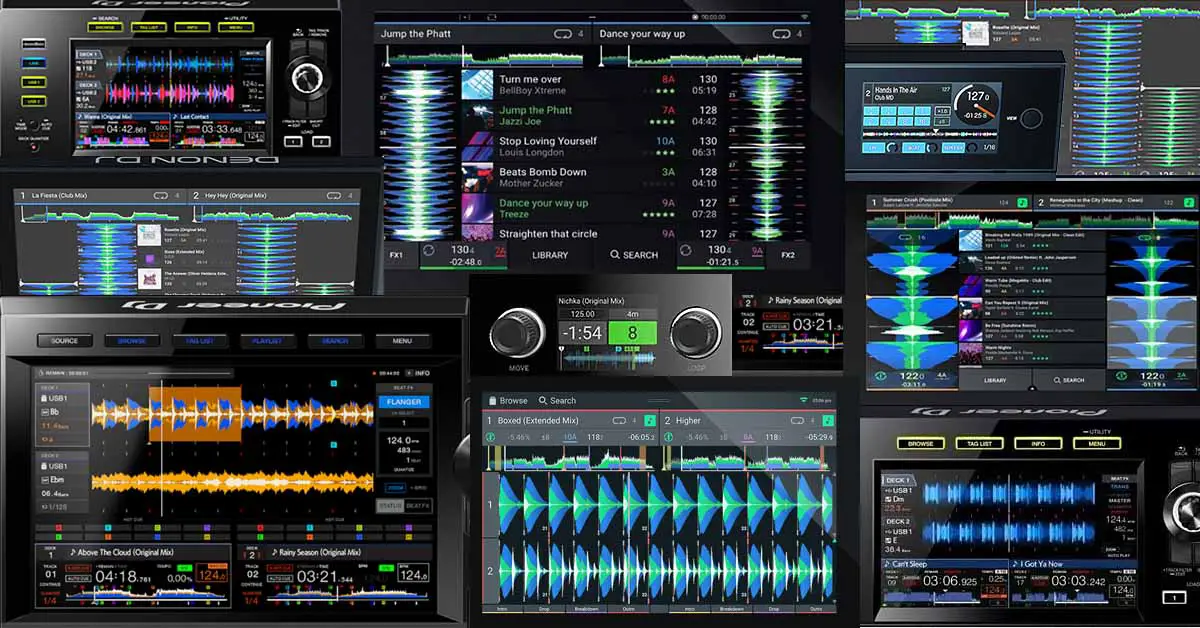
The quick answer is this. The Denon DJ PRIME 4 G2 is the most capable DJ system with a built-in screen available right now. With its 10.1-inch display it has enough screen real estate for true four-deck workflows, the new processor is built for even faster library navigation than in the previous Prime devices, and the system adds onboard Stems rendering, an internal drive bay, deep effects, professional output routing, and a built-in DMX port.
The AlphaTheta XDJ-AZ can be the safer choice for those of you who want current Rekordbox continuity and a club-style/club-standard inspired layout. If two decks are enough, the older XDJ-RX3 remains a very sensible pick with a similarly large screen and more physical control than several newer systems. For portable use, I would look at the Denon DJ PRIME GO+ and Numark Mixstream Pro Go instead.
Every single one of the recommendations below can load and play music from local storage without a laptop. This list contains standalone devices only, so if you’re in a market for a laptop-bound DJ controller instead, you might want to look here: Best DJ Controllers This Year: 8 Picks for Every Type of DJ
This web portal is reader-supported and is part of the AliExpress Partner Program, Amazon Services LLC Associates Program, eBay Partner Network, and Guitar Center Affiliate Program. When you buy using links on our site, we may earn an affiliate commission.
Quick Comparison – All The Units
You can quickly scan this table, if you’re here just for the names and basic info. If, however, you want to know more, I’m going into much more detail below. There are quite a few things that are important to know before you settle on one of these devices.
| Product | Main Screen | Decks | Library Prep | Main Limitation |
|---|---|---|---|---|
| Denon DJ PRIME 4 G2 | 10.1-inch | 4 | Engine DJ | Serato, djay, and VirtualDJ support pending |
| AlphaTheta XDJ-AZ | 10.1-inch | 4 | Rekordbox (OneLibrary) | Large, heavy, and expensive |
| Pioneer DJ OPUS-QUAD | 10.1-inch | 4 | Rekordbox (OneLibrary) | Very large; unconventional pad layout |
| Pioneer DJ XDJ-RX3 | 10.1-inch | 2 | Rekordbox (Device Library) | No Wi-Fi or standalone streaming |
| AlphaTheta XDJ-AN | 7-inch | 2 | Rekordbox (OneLibrary) | One media port; no booth output |
| Denon DJ SC LIVE 4 | 7-inch | 4 | Engine DJ | No external deck inputs |
| Rane SYSTEM ONE | 7-inch | 2 | Engine DJ | Heavy; no external deck inputs |
| Denon DJ PRIME GO+ | 7-inch | 2 | Engine DJ | Small jog wheels and an unusual layout |
| AlphaTheta OMNIS-DUO | 7-inch | 2 | Rekordbox (OneLibrary) | No booth output or external deck inputs |
| Numark Mixstream Pro Go | 7-inch | 2 | Engine DJ | No booth output; one mic input |
A proper standalone screen handles the music source, browser, deck waveforms, cue points, loops, effects, settings, and track loading inside the hardware. You can prepare the library on a computer (or make use of the controller’s in-built streaming features, if present) and then leave your laptop at home. Once again, every device ranked here meets this basic requirement.
The term DJ controller is still commonly used for both categories, even though all-in-one DJ system is, technically, the more accurate name for the hardware covered below. Regardless of that, I will use those interchangeably.
1. Denon DJ PRIME 4 G2 – Best Overall
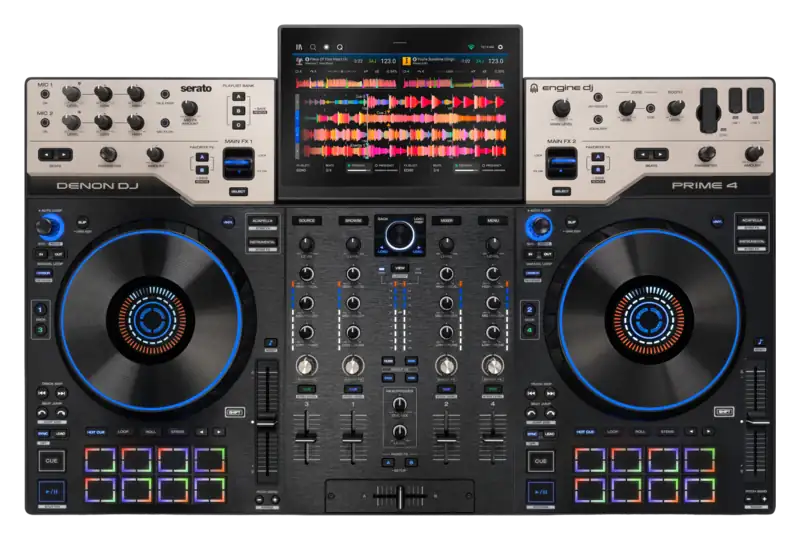
Four-deck Engine DJ flagship with a 10.1-inch bonded touchscreen, onboard Stems rendering, an internal drive bay, extensive effects, and built-in DMX output.
- Fast, information-dense 10.1-inch screen with four-deck room to work.
- Onboard Stems rendering, internal SATA storage, and unusually deep FX control.
- Separate main, booth, and zone outputs plus two microphone inputs.
- Too new to have meaningful long-term reliability data.
- On-the-fly Stems rendering is better handled before a time-critical set.
- Serato, djay, and VirtualDJ integration is still listed as coming soon.
| Type | Four-channel standalone DJ system |
| Standalone Decks | Four |
| Main Display | 10.1-inch, 1280 x 800 optically bonded multi-touch display |
| Jog Wheels | Two 8-inch jog wheels with RGB LED status arrays |
| Performance Pads | Eight MPCe multi-zone pads per deck |
| Standalone Platform | Engine DJ |
| Music Sources | USB-A, USB-C, SD card, optional internal SATA drive, Wi-Fi streaming, Dropbox, Bluetooth input |
| External Audio Inputs | Line/phono inputs on channels 3 and 4 |
| Microphone Inputs | Two XLR / 1/4-inch combo inputs |
| Main / Booth / Zone | XLR main, XLR booth, XLR zone, RCA main |
| Lighting | Integrated 3-pin DMX output and Engine Lighting |
| Dimensions | 762 x 497.1 x 104.9 mm / 30.0 x 19.57 x 4.13 in |
| Weight | 9.9 kg / 21.83 lb |
The Denon DJ PRIME 4 G2 earns the first spot, mainly because it currently requires the fewest compromises from a DJ who wants one box to do almost everything without relying on a laptop connection. Its display is the center of a much faster system than the ones that came before. An 8-core processor and 4 GB of RAM handle browsing, four-deck playback, routing, lighting, effects, and, most importantly, onboard Stems processing. The screen is also optically bonded, which reduces the visible gap between the glass and the image and makes touch interaction feel more direct.
Denon has made much better use of that screen than simply filling it with longer waveforms. A new navigation encoder, Playlist Bank buttons, source shortcuts, multi-touch gestures, and the 1280×800 layout all make large libraries easier to work through. Four decks mean more information in one place, but a 10.1-inch panel gives Engine DJ enough physical room to keep that information readable, which is arguably the most important thing in a controller like this.
Aside from that, there are two external line/phono inputs, two microphone inputs, separate XLR main, booth, and zone outputs, three dedicated media USB ports plus a dual-role USB-C computer/media port, an SD slot, and room for an internal 2.5-inch SATA drive (a common theme with the Prime product line). The integrated DMX connection can remove another adapter from a mobile setup. The new MPCe pads with 4 touch areas for each, as well as expanded effects are also a great addition here.
Denon, as of the time of publishing this ranking, states that Serato DJ Pro, VirtualDJ, and djay support through OmniSource is coming soon. This will probably change in the upcoming months. Once that happens, it will truly be one of the most all-encompassing standalone picks out there.
2. AlphaTheta XDJ-AZ – Best “Club-Standard-Style” Standalone System
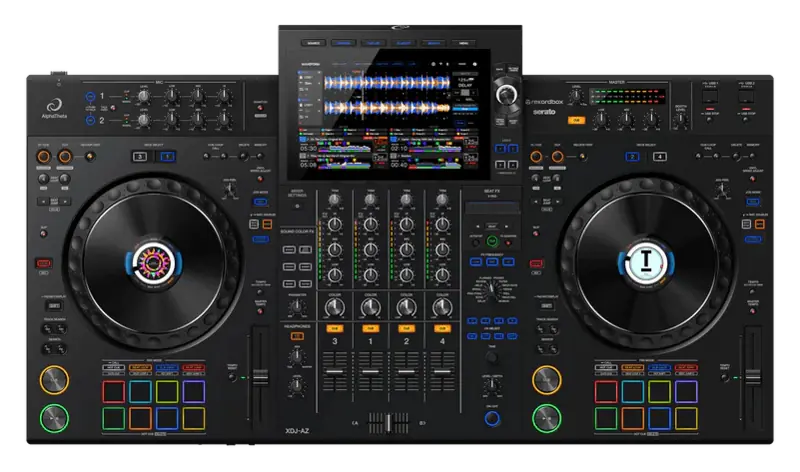
Four-deck Rekordbox-centered standalone system with a 10.1-inch touchscreen, full-size jog wheels, Pro DJ Link, and a current club-style control layout.
- Clear four-deck waveform view and a useful 13-track browser on the 10.1-inch display.
- Full-size jogs and controls derived from current AlphaTheta club hardware.
- Two media USB ports, external deck inputs, booth output, and Pro DJ Link.
- Costs more than several systems with a broader standalone feature set.
- Large enough that transport and booth space need to be planned properly.
- Uses OneLibrary, so an older Device Library USB may need conversion first.
| Type | Four-channel professional all-in-one DJ system |
| Standalone Decks | Four |
| Main Display | 10.1-inch capacitive touchscreen |
| Jog Wheels | Two 206 mm full-size mechanical jog wheels |
| Performance Pads | Eight pads per deck |
| Library / Software | OneLibrary USB; Rekordbox and Serato DJ Pro with a computer |
| Music Sources | Two USB-A ports, Wi-Fi streaming, CloudDirectPlay, Bluetooth input |
| External Audio Inputs | Two line/phono RCA pairs |
| Microphone Inputs | Two XLR / 1/4-inch combo inputs |
| Main / Booth | XLR and RCA main outputs; 1/4-inch TRS booth output |
| Networking | Wi-Fi, LAN, Pro DJ Link, SonicLink |
| Dimensions | 895 x 504.1 x 133.4 mm / 35.24 x 19.85 x 5.25 in |
| Weight | 13.5 kg / 29.8 lb |
The Pioneer XDJ-AZ is the system I would put in front of someone who prepares in Rekordbox and wants a layout that transfers cleanly to current AlphaTheta club equipment. Its full-size jog wheels are derived from the CDJ-3000 design, while the four-channel mixer follows the general DJM-A9 arrangement. That familiarity is the reason to choose it over the PRIME 4 G2. All in all, it’s trying its best to be a close imitation of a club standard CDJ setup, just like its predecessor – the XDJ-XZ.
Its 10.1-inch display can now handle two- or four-deck waveform views, and the browser can show up to 13 tracks at once. Touch Preview, Touch Cue, Playlist Bank, and shortcut controls reduce the amount of menu digging during a set. This is also a better screen setup than the old XDJ-XZ offered, as the AZ can finally play all four standalone decks, not just mix four sources while limiting USB playback to two decks (yes, it was a thing with the XZ).
Two top-mounted USB ports, which are slowly becoming a standard on modern DJ gear, make back-to-back handovers and an immediate backup drive straightforward. Pro DJ Link, a LAN port, Wi-Fi, CloudDirectPlay, current streaming services support, and external line/phono inputs give the system enough flexibility for home, events, and booth installation. The same point applies to the outputs. We have balanced main and booth connections here, along with two separate microphone inputs.
The AZ is both wider and considerably heavier than it looks in photos. In fact, it’s the heaviest unit on this list. What’s also important to mention is that it expects a OneLibrary USB database on your storage devices. Rekordbox can now export both current OneLibrary and older Device Library data, but a drive prepared only for older players needs to be converted before the AZ can read its library information properly.
3. Pioneer DJ OPUS-QUAD – Best System With Three Separate Displays
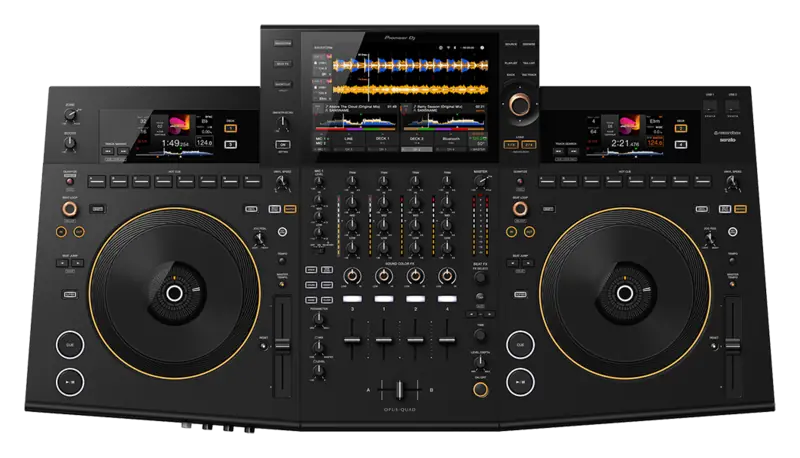
Four-deck standalone system built around a 10.1-inch central touchscreen, two deck displays, zone output, full-size jogs, and an event-oriented design.
- Central multi-touch display and separate deck screens divide information sensibly.
- Four standalone decks, zone output, two microphone inputs, and external-source mixing.
- OneLibrary, cloud access, and current Apple Music, Beatport, and TIDAL support.
- One of the widest and most awkward systems here to transport.
- No conventional performance-pad rows under the jog wheels.
- The styling and smooth control finish will not suit every DJ.
| Type | Four-channel professional all-in-one DJ system |
| Standalone Decks | Four |
| Displays | 10.1-inch capacitive touchscreen plus two deck displays |
| Jog Wheels | Two 206 mm full-size mechanical jog wheels |
| Hot Cues | Eight dedicated hot-cue buttons per deck |
| Library / Software | OneLibrary USB; Rekordbox and Serato DJ Pro hardware unlock |
| Music Sources | Two top USB ports, rear USB 3.2, Wi-Fi streaming, CloudDirectPlay, Bluetooth input |
| External Audio Inputs | Two line/phono RCA pairs |
| Microphone Inputs | Two microphone inputs |
| Main / Booth / Zone | XLR and RCA main, 1/4-inch TRS booth, XLR zone |
| Dimensions | 925.7 x 499.7 x 142 mm / 36.44 x 19.67 x 5.59 in |
| Weight | 13.2 kg / 29.1 lb |
The OPUS-QUAD, our ugly duckling from AlphaTheta, still can be a good purchase, if you get it at the right price. Its central 10.1-inch screen handles the browser and overall workflow, while the two smaller deck displays position track information closer to the jog wheels. That separation is quite original, and truth be told, pretty useful on a four-deck system.
A dedicated zone output is a good reason mobile and wedding DJs could consider it. You can send a separate source to another room while the main mix continues. The unit also has the microphone and external-input connections expected at this price. Apple Music, Beatport Streaming, and TIDAL support have also arrived since my original write-up on the OPUS-QUAD, fixing one of the bigger launch-era omissions.
I am still less convinced by the smooth control styling than by the system underneath it. The winged chassis is enormous and can be awkward to position, the hot-cue buttons sit above the jogs, and there are no traditional performance-pad rows on here. DJs who use Sampler, Slicer, and pad rolls heavily should look closely at that layout before taking the plunge.
The XDJ-AZ is the more natural purchase for direct club practice, but it’s also much more expensive. The OPUS-QUAD earns its place with a lower price, zone output, and the three-display layout. That’s pretty much it.
4. Pioneer DJ XDJ-RX3 – Best Two-Channel Professional System
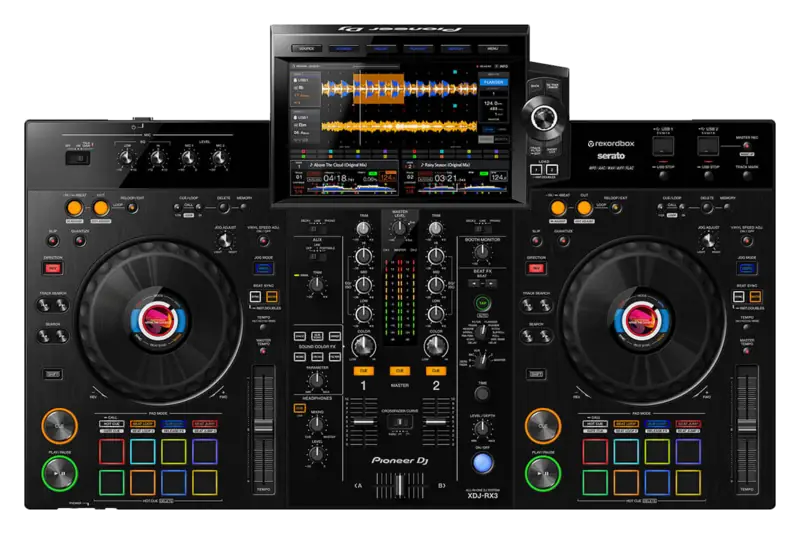
Mature two-deck standalone system with a 10.1-inch touchscreen, jog-center displays, deep physical FX control, dual media USB ports, and professional audio connections.
- Large, proven touchscreen with fast browsing, Touch Preview, and twelve-track lists.
- Dedicated Beat FX and Sound Color FX controls keep routine mixing off the screen.
- Two media USB ports and proper inputs for turntables, players, microphones, and an aux source.
- Only two standalone decks and no onboard Wi-Fi or streaming services.
- Uses Device Library rather than the newer OneLibrary format.
- Smaller jog wheels than the XDJ-AZ and OPUS-QUAD.
| Type | Two-channel performance all-in-one DJ system |
| Standalone Decks | Two |
| Displays | 10.1-inch touchscreen plus two jog-center color LCDs |
| Performance Pads | Eight pads per deck |
| Effects | 14 Beat FX and 6 Sound Color FX |
| Library / Software | Device Library USB; Rekordbox and Serato DJ Pro with a computer |
| Music Sources | Two USB-A media ports, Rekordbox Link Export, computer USB |
| External Audio Inputs | Two line/phono inputs plus line and portable aux inputs |
| Microphone Inputs | Two microphone inputs |
| Main / Booth | XLR and RCA main outputs; 1/4-inch TRS booth output |
| Dimensions | 728.1 x 469.5 x 118.4 mm / 28.67 x 18.48 x 4.66 in |
| Weight | 9.3 kg / 20.5 lb |
The Pioneer XDJ-RX3 has been around since 2021, and that maturity surprisingly works in its favor. The 10.1-inch touchscreen is quick to browse (although it’s not a modern capacitive display), it shows up to 12 tracks, supports Touch Preview and basic gesture control, and gives you a large combined waveform view without the density of four simultaneous decks.
A large part of the RX3 workflow remains physical, which I really like. You get the full 14 Beat FX and 6 Sound Color FX selection, dedicated timing and assignment controls, eight performance pads per deck, and useful jog-center LCDs. That is still a very good arrangement for a DJ who wants the screen to handle browsing and visual feedback without turning the whole mixer into a menu.
The back panel is a major reason the RX3 has aged so well. Unlike the much newer XDJ-AZ, the RX3 features a dedicated AUX section with its own volume knob, letting you plug in a backup phone without sacrificing a mixer channel. There is no onboard Wi-Fi or standalone streaming, and two decks are the limit when playing from USB. The RX3 also reads the older Device Library format rather than OneLibrary.
None of those points are hidden costs if they match how you already work. For a prepared local library and a conventional two-deck set, this remains one of the easiest systems here to trust and operate, especially if you can find it for a good price second-hand.
You might also like: Pioneer XDJ-RX3 vs. XDJ-RX2 (Direct Comparison)
5. AlphaTheta XDJ-AN – Best Current Rekordbox Entry Point
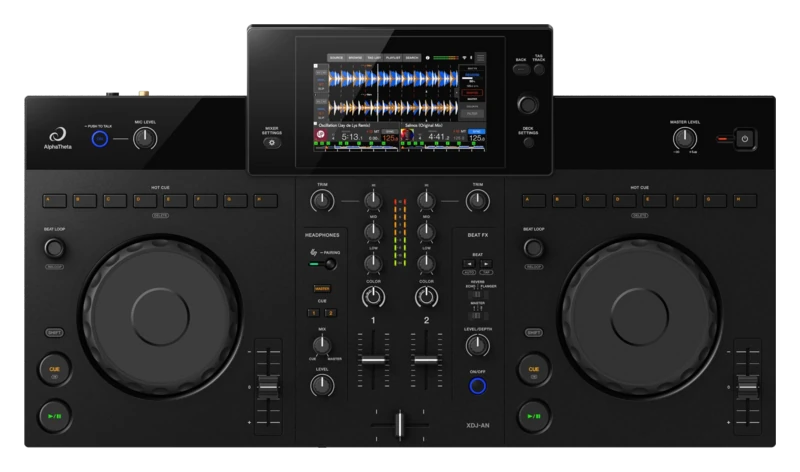
Compact two-deck standalone system with a 7-inch touchscreen, OneLibrary, USB-C media, cloud and streaming access, and an AlphaTheta club-style layout.
- Current OneLibrary workflow with USB, cloud, streaming, and mobile-device sources.
- Useful browser details, track preview, and playlist editing on the 7-inch screen.
- Compact enough to move around without giving up full-length pitch faders.
- One USB-C media port gives you no second local drive handover or backup slot.
- No booth output, external deck inputs, or XLR microphone input.
- Only three Beat FX, with several routine settings handled on the screen.
| Type | Two-channel all-in-one DJ system |
| Standalone Decks | Two |
| Main Display | 7-inch, 1024 x 600 touchscreen |
| Jog Wheels | Two 132 mm jog wheels |
| Hot Cues | Eight buttons per deck |
| Library / Software | OneLibrary USB; Rekordbox, Serato DJ Lite/Pro, and djay with supported devices |
| Music Sources | One USB-C storage port, Wi-Fi streaming, CloudDirectPlay, Bluetooth input |
| Microphone Input | One 1/4-inch TRS input |
| Main Output | XLR and RCA main outputs |
| Booth / External Deck Inputs | None |
| Wireless | Wi-Fi, Bluetooth input/output, SonicLink |
| Dimensions | 638 x 359.2 x 89.9 mm / 25.1 x 14.1 x 3.5 in |
| Weight | 5.2 kg / 11.5 lb |
The XDJ-AN is the current lower-priced route into an AlphaTheta standalone workflow. Its 7-inch screen combines the source menu, browser, preview waveform, deck view, mixer settings, and playlist editing. Music can come from OneLibrary USB storage, Rekordbox CloudDirectPlay, supported streaming services, or a connected mobile device. Its overall shell design is pretty minimalistic, to say the least.
The display is doing more work here than on the RX3. There are only three hardware Beat FX, and several deck and mixer settings live in touch menus. AlphaTheta has at least designed those screens around the job. The track lists can include artwork, BPM, key, and preview information, while the QR login avoids typing full account details on the controller, which is overall a neat addition. Apple Music, Beatport, and TIDAL are all supported in the standalone mode.
The serious limitations are on the rear panel. There is one USB-C storage port, one microphone input, no booth output, and no external deck inputs. That single media slot matters more than it first appears because you cannot keep a second local drive connected or perform a standard USB handover between DJs.
This is a good home and small-event system for someone who specifically wants current Rekordbox and OneLibrary support for a reasonable price. The RX3 costs more and lacks streaming, but its physical FX section, dual USB inputs, external-source mixing, and booth connection make it the more complete professional tool.
6. Denon DJ SC LIVE 4 – Best Affordable Four-Deck System
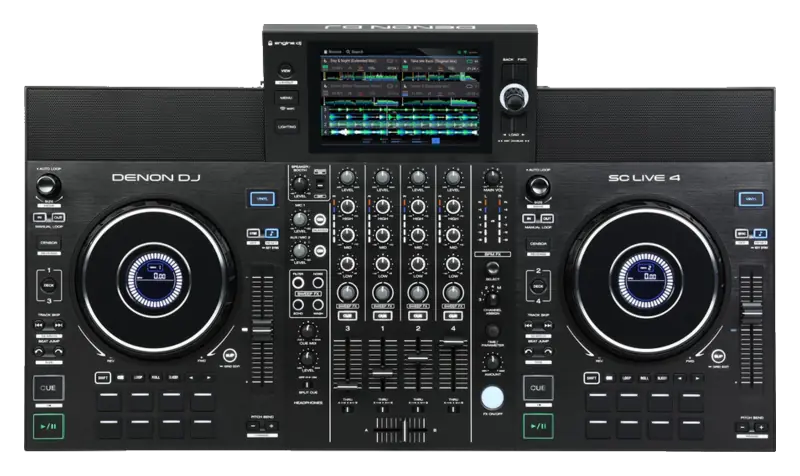
Four-deck Engine DJ system with a 7-inch touchscreen, built-in speakers, wide streaming support, Serato DJ Pro unlock, and balanced main and booth outputs.
- Four real standalone decks at a much lower entry point than the current flagships.
- Two USB ports and an SD slot make local-media handovers and backups easy.
- Built-in speakers, broad streaming access, and Serato DJ Pro unlock add genuine flexibility.
- Four stacked waveforms make the 7-inch display noticeably busier.
- No line/phono deck inputs or standalone mixer use for external players.
- The lightweight plastic-heavy build feels less substantial than premium systems.
| Type | Four-channel standalone DJ system |
| Standalone Decks | Four |
| Main Display | 7-inch multi-gesture touchscreen |
| Performance Pads | Eight pads per deck |
| Built-In Speakers | Yes, with independent volume and on/off control |
| Library / Software | Engine DJ; Serato DJ Pro included; VirtualDJ requires a license |
| Music Sources | Two USB-A ports, SD card, Wi-Fi streaming, Dropbox, Bluetooth input |
| External Audio Input | RCA auxiliary input only |
| Microphone Inputs | One XLR / 1/4-inch combo plus one 1/4-inch TRS |
| Main / Booth | XLR and RCA main outputs; 1/4-inch TRS booth output |
| Dimensions | 718.8 x 403.9 x 99.1 mm / 28.3 x 15.9 x 3.9 in |
| Weight | 5.8 kg / 12.8 lb |
The Denon DJ SC LIVE 4 is the practical way to get four standalone decks without paying flagship money. Engine DJ runs from a 7-inch multi-gesture screen, with Layer buttons switching the physical controls between decks 1/3 and 2/4. It can also unlock Serato DJ Pro when connected to a computer, which gives the unit a useful second life outside the standalone mode.
The screen is both the strength and the obvious limit. Two-deck operation is comfortable, but four stacked waveforms, library details, deck status, and effect information can be a little bit too much for a display of this size. There are several things the price does not force you to lose. You get two USB storage ports, an SD slot, Apple Music and Amazon Music Unlimited among the streaming options, built-in speakers, two microphone inputs, balanced XLR main, and balanced booth output.
The speakers work well for practice, preparation, and personal monitoring. They are not meant to cover a room like a PA system. The lightweight construction rivaled only by the much smaller DJ PRIME GO+ is helpful when you have to carry it, although it does feel more plastic-heavy than the RX3 or flagship Denon systems. There are also no line/phono deck inputs, so the four channels belong to the internal or software decks rather than a flexible standalone mixer. For the money, those compromises are much easier to accept than they would be on a premium unit.
7. Rane SYSTEM ONE – Best Motorized Standalone System
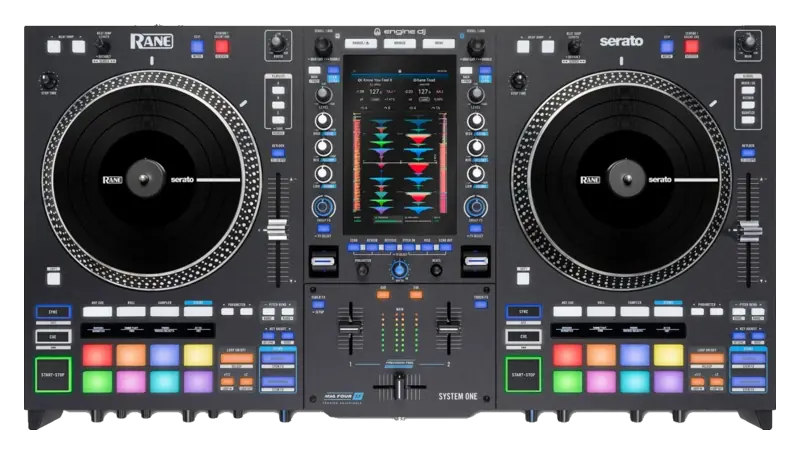
Two-deck standalone Engine DJ and Serato system with a 7-inch touchscreen, 7.2-inch motorized platters, internal effects, extensive media support, and scratch-focused controls.
- The only current system combining standalone playback with proper motorized platters.
- Dual browse encoders, Playlist Banks, and swipe-to-deck loading suit a two-deck screen workflow.
- Three USB-A ports, USB-C media, SD, and an internal SATA bay cover serious libraries.
- No line/phono deck inputs or standalone mixer mode through the main channels.
- At 29.4 lb before a case, this is not casual portable equipment.
| Type | Two-channel motorized standalone DJ system |
| Standalone Decks | Two |
| Main Display | 7-inch multi-touch display |
| Platters | Two 7.2-inch motorized platters with removable control discs |
| Performance Pads | Eight pads plus a secondary pad area per deck |
| Library / Software | Engine DJ standalone; Serato DJ Pro 4.0.3 or later |
| Music Sources | Three USB-A ports, USB-C media, SD card, optional internal SATA drive, streaming, Dropbox |
| External Audio Input | RCA auxiliary input only |
| Microphone Inputs | Two XLR / 1/4-inch combo inputs |
| Main / Booth | XLR and RCA main outputs; 1/4-inch booth output |
| Dimensions | 736.6 x 403.0 x 144.7 mm / 29.0 x 15.87 x 5.70 in |
| Weight | 13.33 kg / 29.4 lb |
The SYSTEM ONE is the specialist mobile scratch DJ choice on this list. It is currently the only standalone system that combines an Engine DJ touchscreen with proper motorized platters and removable control discs. The screen can browse local media, streaming sources, and Serato, while separate load encoders let you push a track to either deck without dragging everything through one central control.
Rane also gives the library workflow some useful shortcuts. Three Playlist Bank buttons can recall frequently used local or streaming playlists, tracks can be swiped directly to a deck, and there are dedicated source controls. Storage is also very complete, as you get three USB-A ports, a USB-C media port, SD, and an optional internal 2.5-inch SATA drive.
The SYSTEM ONE requires a different library workflow from the laptop-based Rane ONE. Engine DJ needs its own prepared library, and Rane recommends using a dedicated export drive rather than exporting back onto the drive that stores the source music. Serato DJ Pro support is current from version 4.0.3, while djay and VirtualDJ remain future additions.
The missing external-deck inputs are the main hardware disappointment here. The RCA aux input can accept a line source, but the two mixer channels cannot become a standalone mixer for turntables or media players. At 29.4 lb, the system also needs a serious case and a realistic transport plan. My separate guide to the best motorized DJ controllers covers the platter and scratch-control side in much more detail, if you’d like to know more about that.
8. Denon DJ PRIME GO+ – Best Compact Professional Option
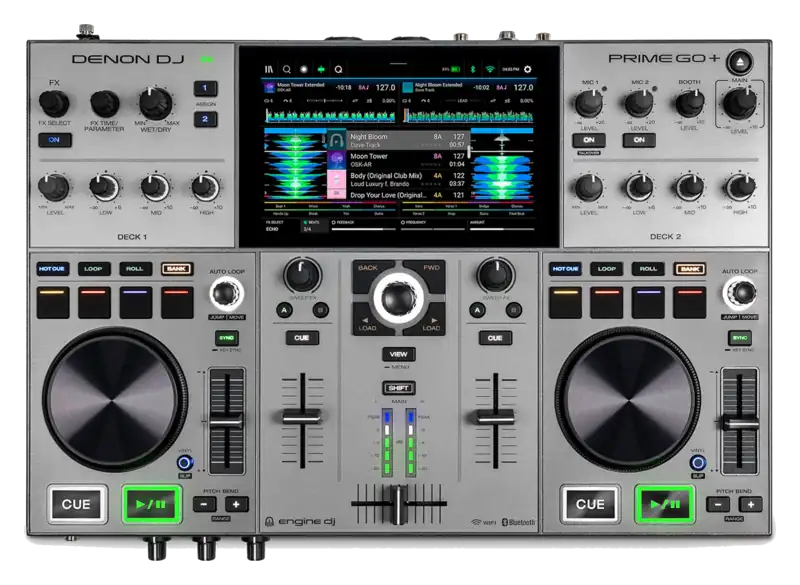
Battery-powered two-deck Engine DJ system with a customizable 7-inch touchscreen, professional microphone and output connections, broad streaming, and a very compact footprint.
- Customizable waveform and library layouts make good use of the compact 7-inch screen.
- XLR main, balanced booth, two combo microphone inputs, and RCA aux suit paid event work.
- USB, SD, battery power, streaming, Bluetooth, and Day Mode cover a wide range of locations.
- Small jog wheels and short pitch controls limit fine manual adjustments.
- The horizontal mixer layout takes time to learn if you are used to conventional controllers.
- No built-in speakers despite its portable design.
| Type | Two-channel portable standalone DJ system |
| Standalone Decks | Two |
| Main Display | 7-inch multi-gesture touchscreen with custom views and Day Mode |
| Performance Pads | Four dual-layer pads per deck |
| Battery | Built-in rechargeable battery; rated 25% longer than the original PRIME GO |
| Standalone Platform | Engine DJ |
| Music Sources | USB-A, SD card, Wi-Fi streaming, Dropbox, Bluetooth input |
| External Audio Input | RCA auxiliary input |
| Microphone Inputs | Two XLR / 1/4-inch combo inputs |
| Main / Booth | XLR and RCA main outputs; balanced 1/4-inch booth output |
| Dimensions | 411 x 274 x 53 mm / 16.2 x 10.8 x 2.1 in |
| Weight | 3.68 kg / 8.11 lb |
The PRIME GO+ is the ultra-portable system I would trust first for a small paid event, a backup setup, or a job where table space is extremely limited. Its body is only 16.2 inches wide, yet it still has XLR main, balanced booth, two combo microphone inputs, an RCA auxiliary input, USB storage, and an SD slot.
Its 7-inch screen has three customizable layouts, vertical or horizontal waveform options, and a Day Mode that reverses the contrast outdoors. Hiding pad or effect information when you do not need it is a smart way to preserve library space on a small panel. Engine DJ also provides far deeper built-in effect control than the small compact surface suggests.
Portability has dictated the unusual shape. The mixer controls sit across the top, the jog wheels are very small, and the pitch faders are short. That is fine for prepared two-deck mixing and can understandably be awkward for long manual blends or anyone who wants to scratch. The controls will also take a little relearning if every other setup you use has a central mixer. For a system this small and this capable, it’s pretty much the only choice out there as of now, alongside its predecessor.
You might also like: AlphaTheta OMNIS-DUO vs. Denon DJ Prime GO – How It Really Is
9. AlphaTheta OMNIS-DUO – Best Portable Rekordbox System
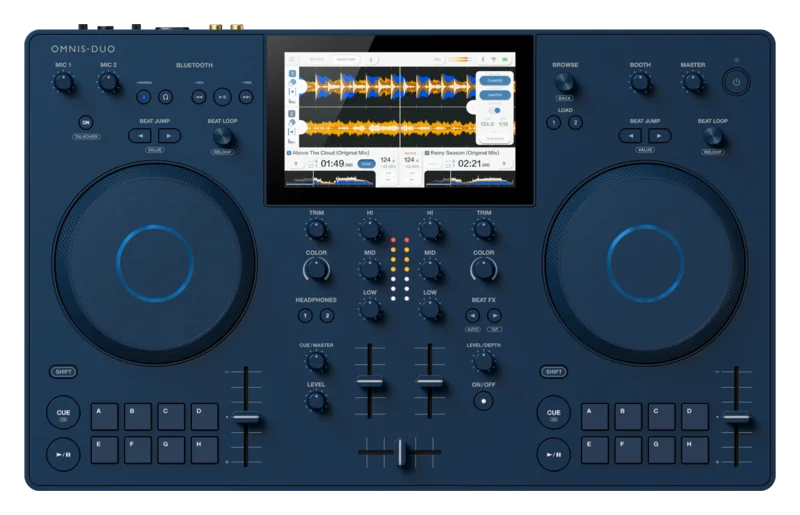
Portable two-deck OneLibrary system with a 7-inch touchscreen, conventional deck layout, battery power, Light and Dark display modes, and XLR main output.
- Light and Dark screen modes, good library filtering, and Touch Preview work well away from home.
- Conventional two-deck layout and larger jogs feel more familiar than the PRIME GO+ arrangement.
- Battery power, USB, SD, cloud, streaming, and Rekordbox integration provide plenty of source choices.
- Many common actions still live on small touchscreen controls instead of dedicated buttons.
- No built-in speakers, external deck input, or fully separate booth output.
- PRIME GO+ offers stronger event connectivity and more control depth for the money.
| Type | Two-channel portable all-in-one DJ system |
| Standalone Decks | Two |
| Main Display | 7-inch touchscreen with Light and Dark modes |
| Performance Controls | Eight Hot Cue buttons, Beat Jump, loop controls, 8 Beat FX, 6 Sound Color FX |
| Battery | Approximately 5 hours; 45 W USB-C power-bank support |
| Library / Software | OneLibrary USB; Rekordbox and Serato with a computer |
| Music Sources | USB-A, SD card, Wi-Fi streaming, CloudDirectPlay, Bluetooth input |
| Microphone Inputs | Two microphone inputs |
| Main / Booth | XLR main; RCA output can serve as master or booth |
| Wireless Output | Bluetooth and SonicLink-compatible output |
| Dimensions | 500 x 307 x 71 mm / 19.7 x 12.1 x 2.8 in |
| Weight | 4.6 kg / 10.1 lb |
The AlphaTheta OMNIS-DUO is the portable option for someone who wants to stay inside the Rekordbox and OneLibrary ecosystem. The minimalist deck layout is much more conventional than the PRIME GO+ arrangement, the jog wheels are larger, and the 7-inch touchscreen has separate Light and Dark modes.
I still prefer direct hardware controls wherever there is room for them, and that remains my largest complaint here. Sync, slip, jog modes, and many smaller settings are handled only through the display. The library side is better thought out, as Touch Preview, detailed filtering, search, waveform options, and playlist management make the screen useful for more than loading a track.
Since my first full OMNIS-DUO overview, AlphaTheta has added direct Apple Music, Beatport Streaming, and TIDAL support to the device. The system can also read USB and SD media, use CloudDirectPlay, accept Bluetooth audio, and run for approximately five hours under the manufacturer rating. A proper XLR output is also present here.
The price, however, remains hard to ignore. There are no built-in speakers or external deck inputs, and the RCA connection doubles as either a second master or booth output rather than giving you two fully independent routes. The PRIME GO+ has smaller controls and an odd layout, but it still offers more event connectivity and effects for the money. My OMNIS-DUO vs. PRIME GO comparison goes through that choice point by point.
10. Numark Mixstream Pro Go – Best Beginner Portable Controller
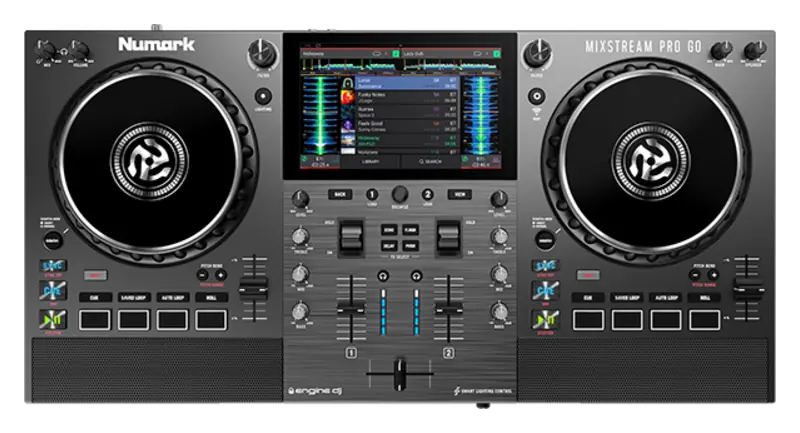
Approachable battery-powered Engine DJ system with a 7-inch touchscreen, built-in speakers, 6-inch jog wheels, two USB ports, SD storage, and Wi-Fi streaming.
- Battery and speakers make it the easiest complete practice setup to carry outside.
- The 7-inch Engine DJ screen handles browsing, analysis, streaming, FX, and lighting directly.
- Two USB inputs and an SD slot are unusually generous at this price level.
- One microphone input and no booth output restrict more demanding event setups.
- Four pads and a simplified hardware FX section leave less direct performance control.
- The speakers are for practice or monitoring, not for covering a party without a PA.
| Type | Two-channel portable standalone DJ system |
| Standalone Decks | Two |
| Main Display | 7-inch multi-gesture high-definition touchscreen |
| Jog Wheels | Two 6-inch capacitive-touch jog wheels |
| Performance Pads | Four dual-layer pads per deck |
| Battery / Speakers | Built-in rechargeable battery and adjustable onboard speakers |
| Standalone Platform | Engine DJ |
| Music Sources | Two USB-A ports, SD card, Wi-Fi streaming, Dropbox, Bluetooth input |
| Microphone Input | One 1/4-inch input |
| Main / Booth | XLR and RCA main outputs; no booth output |
| Dimensions | 566 x 284 x 74 mm / 22.3 x 11.2 x 2.9 in |
| Weight | 3.68 kg / 8.11 lb |
The Numark Mixstream Pro Go puts the fewest obstacles between a beginner and a complete standalone setup, and comes at a really good price. Charge the battery, load an Engine DJ library or sign in to a supported streaming service, and the built-in speakers are enough to practice without setting up a separate sound system. The 7-inch screen handles browsing, track analysis, waveforms, effects, and lighting controls.
The deck layout is easier to understand at first glance than the PRIME GO+ layout. Six-inch jog wheels, a three-band EQ, dedicated filters, normal pitch faders, and Smart Scratch make the basics approachable. Four dual-layer pads per deck and four hardware effect toggles are enough to learn on, though performance-focused DJs will eventually want more direct controls.
Two USB media ports and an SD slot are excellent at this level. The “professional side” is quite understandably thinner. There is one microphone input, no booth output, and no external deck inputs. XLR main output is present, so the controller can feed a proper PA, but it is less convenient when a separate monitor mix or two microphones are required.
Choose the Mixstream Pro Go when the battery, speakers, straightforward layout, and lower cost are the point. The PRIME GO+ is smaller and much better connected for event work. My older Numark Mixstream platform overview explains the basic family workflow, although the Pro Go adds battery operation and has received substantial Engine DJ updates since the original came out.
What About Older DJ Systems With Screens?
Several older units can still be useful on the second-hand market, but aside from maybe the Denon DJ Prime 4/4+, in most cases they should not really be considered as first new picks. This is the short version of where they stand today.
| Older Model | Current Direction | Still Worth Considering? |
|---|---|---|
| Denon DJ PRIME 4 / PRIME 4+ | Denon DJ PRIME 4 G2 | Yes. The PRIME 4+ remains a strong buy when meaningfully cheaper; the original PRIME 4 still makes sense used at the right price. |
| Denon DJ PRIME 2 | Denon DJ SC LIVE 2 (nearest option) | Yes, at the right used price. There is no direct PRIME 2 replacement, and the SC LIVE 2 is the nearest current two-deck Engine DJ system. |
| Denon DJ PRIME GO | Denon DJ PRIME GO+ | Yes. The layout and core workflow remain close; the GO+ mainly adds longer battery life and broader streaming support. |
| Pioneer DJ XDJ-XZ | AlphaTheta XDJ-AZ | Yes, at the right price, but USB playback is limited to two decks and it uses the older Device Library format. |
| Pioneer DJ XDJ-RX2 | Pioneer DJ XDJ-RX3 | Partly, when substantially cheaper. The RX3 adds a larger 10.1-inch screen, faster browsing, and a more current effects workflow. |
| Pioneer DJ XDJ-RR | AlphaTheta XDJ-AN or Pioneer DJ XDJ-RX3 | Only at a good used price. It remains a basic two-deck Device Library system, while both alternatives offer newer workflows. |
| Numark Mixstream Pro | Numark Mixstream Pro+ or Pro Go | Yes, if you do not need Amazon Music Unlimited support or battery power. The Mixstream Pro+ is still a current model. |
Recap – And My Final Recommendation
The Denon DJ PRIME 4 G2 is the strongest overall package today if you want four standalone decks, a large screen, onboard Stems, deep effects, internal storage, professional routing, and lighting control in one system. The AlphaTheta XDJ-AZ is viable when Rekordbox, club familiarity, full-size jog wheels, and Pro DJ Link carry more weight for you than Denon’s extra performance features.
The XDJ-RX3 remains my practical two-channel professional pick, despite its age. It lacks streaming, but the larger screen, physical FX, dual USB inputs, external-source connections, and mature workflow make a very convincing combination, even after a few years have passed since its release.
For portable work, the PRIME GO+ is the most complete professional tool, while the OMNIS-DUO is the Rekordbox-centered alternative, and the Mixstream Pro Go is the easiest battery-and-speakers package for a beginner. Work backward from where you will play, how the music will be stored, and which connections the job requires. The best screen is the one attached to the system that still solves those three things. Rock on!
You can also browse our main DJ Gear Database if you want to compare the specifications of these and other DJ systems directly.