
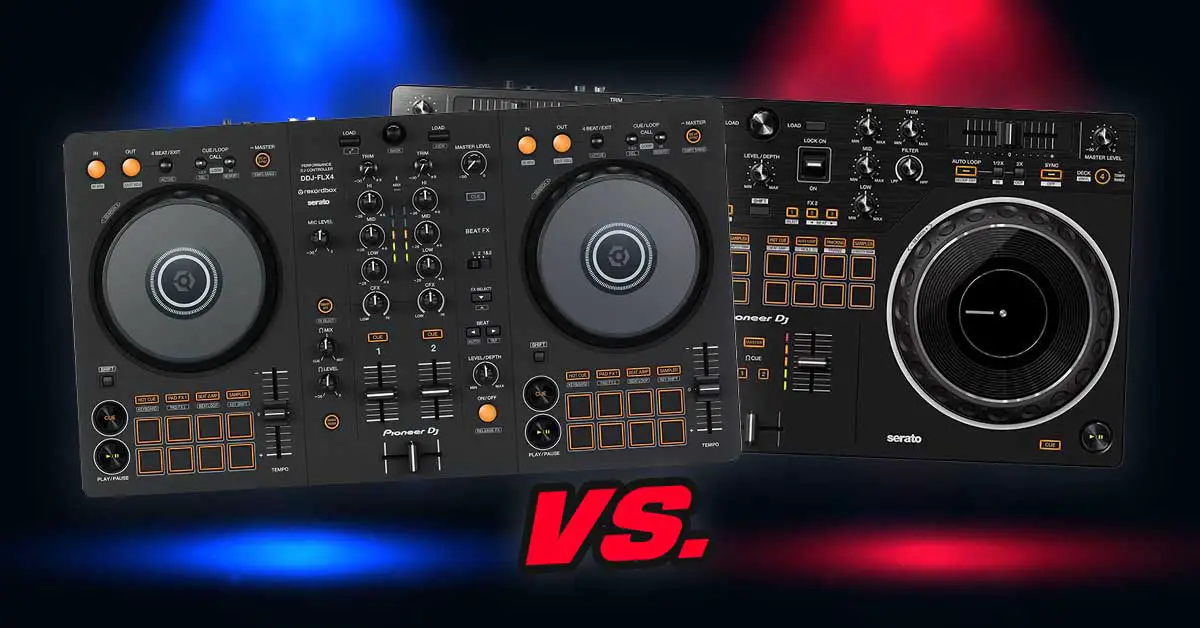
We’re about to compare all the features, DJ software support, use cases and affordability of the two of the most popular Pioneer DJ entry-level DJ controllers, the Pioneer DDJ-Rev1 and the DDJ-FLX4. Let’s take a closer look at the two devices and find out which one of these will be a better choice for you in the end.
This web portal is reader-supported and is part of the AliExpress Partner Program, Amazon Services LLC Associates Program, eBay Partner Network, and Guitar Center Affiliate Program. When you buy using links on our site, we may earn an affiliate commission.
Pioneer DDJ-FLX4 vs. Pioneer DDJ-REV1 – full specification comparison
| Specs |
|---|
DDJ-FLX4 vs. DDJ-Rev1 – control layouts
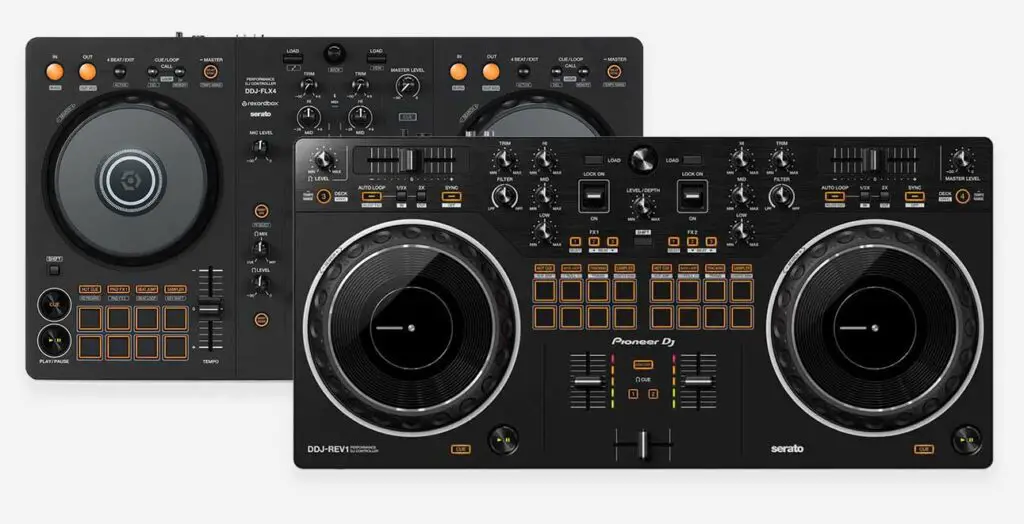
The Pioneer DDJ-FLX4 has become the official replacement for the now discontinued Pioneer DDJ-400 quite some time ago. Generally speaking it’s an overall upgrade of its predecessor, having a few more neat features on board and an updated front panel design. You can read much more about the differences between the two controllers in my full feature comparison here.
Pioneer DDJ-FLX4 is an entry-level DJ controller directed towards beginner DJs who prefer the so-called club control layout – that is a control scheme that is meant to represent two Pioneer CDJ players and a DJM mixer in between.
Pioneer DDJ-Rev1 on the other hand, is designed to be a treat for all beginner scratch DJs who simply need an affordable entry-level DJ controller featuring a battle-style control layout. This kind of layout basically resembles two turntables rotated by 90 degrees and a scratch mixer (Pioneer DJM-S series to be exact) between them. One of the main differences here in comparison to the club layout would be the pitch faders and performance pads positioning.
Some people that are used to the “standard” club layout that has been present on all previous entry-level Pioneer DJ controllers dislike the battle style control positioning, and on the other hand, some scratch DJing enthusiasts welcome the possibility to make use of it on a smaller sized device like the Rev1. Purely a matter of personal preference.
All in all though, if you’re just starting out and you don’t have any preferences when it comes to the DJ controller layout, the choice between these two should in my opinion be based on the slight differences in the feature sets of both of these devices which are in the end, in my opinion, much more meaningful than the mentioned differing design choices. More on that in a short while.
Choosing the battle style layout over the club layout or the other way around isn’t really that meaningful if you haven’t really used a DJ controller before. With that said, let’s continue to the main features comparison to help you decide between these two equally capable and similarly priced devices.
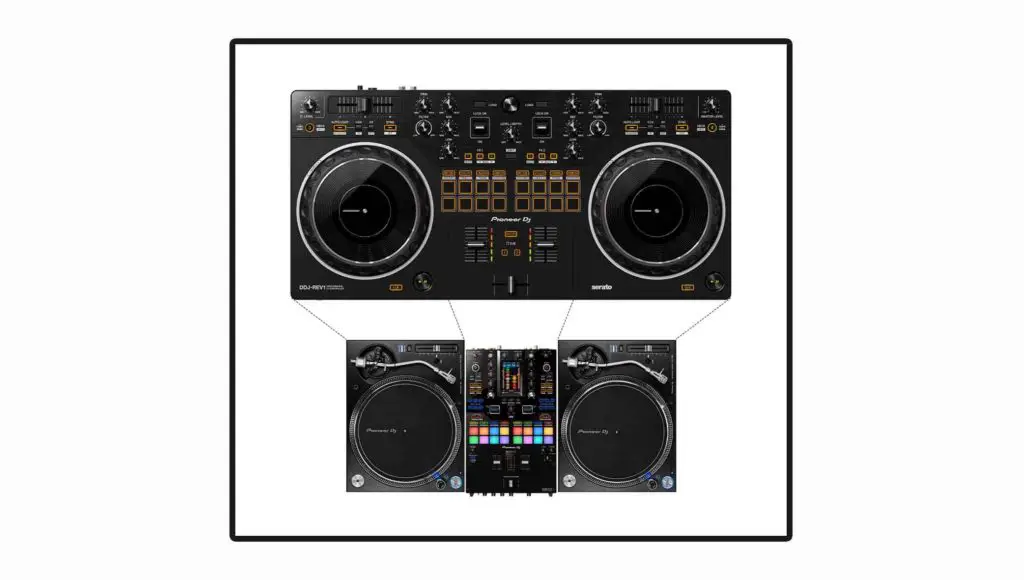
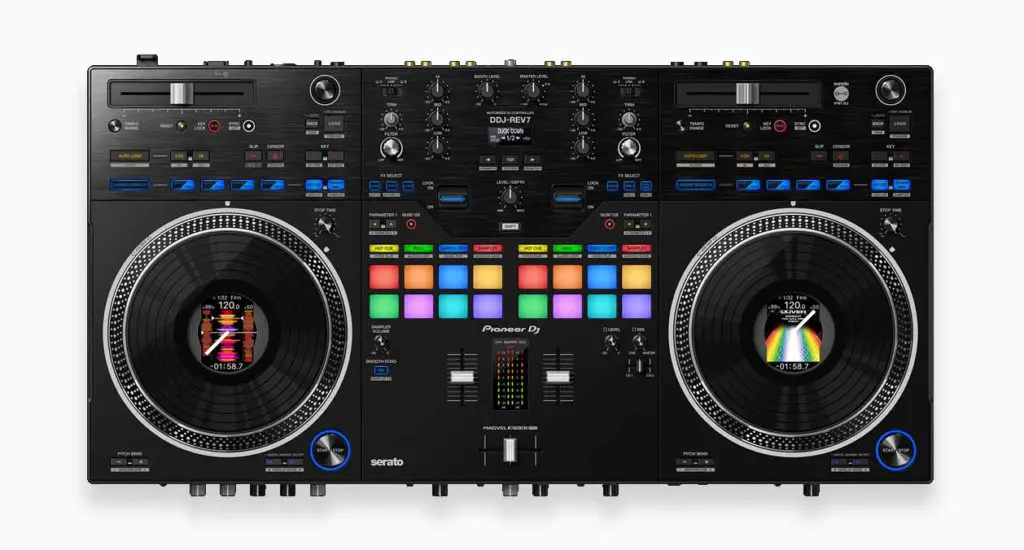
If the concept of the battle-style layout has caught your interest, you might want to take a look at one of Pioneer’s higher-end battle-style DJ controllers – the Pioneer DDJ-Rev7. While this one is much more expensive than the two entry-level devices I’m comparing in this article, it’s also one of the most capable DJ controllers for scratch DJs that exist on the market as of now. See the image below!
Software compatibility – a major difference
While the Pioneer DDJ-Rev1 is a dedicated Serato DJ controller by design, the Pioneer DDJ-FLX4 has much broader software support. It officially works with Rekordbox, Serato DJ Lite, djay and Traktor Play, and it can also be used with VirtualDJ.
In case of the DDJ-FLX4, right after purchasing it, you can use Rekordbox Performance mode through Hardware Unlock, or Serato DJ Lite – a much cut down version of Serato DJ Pro. You of course have the ability to do a paid upgrade to Serato DJ Pro for more unlocked controller functions and software features.
The FLX4 now also supports Rekordbox on iOS and Android, either via USB or Bluetooth.
Pioneer DDJ-Rev1 comes just with Serato DJ Lite and no Rekordbox support. An upgrade to Serato DJ Pro is possible and highly advised if you prefer to use it in the long run. Keep that in mind, because many useful features of the Serato DJ software are simply soft-locked in the Lite version. For us, a little bit too many. More on the substantial differences between Serato DJ Lite and Pro here: Serato DJ Lite vs. Pro (12 Most Important Differences
The Rev1 can also effectively be used with both VirtualDJ (without additional setup), or with Traktor (provided you have appropriate mapping files on hand).
Performance pads
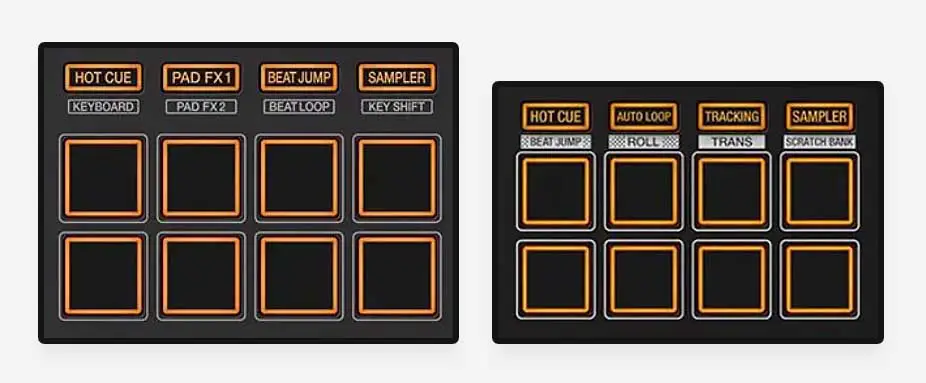
The first major difference when it comes to the performance pads is their positioning on both devices. The Pioneer DDJ-FLX4 follows the classic formula of placing the pads on each of the decks under a jog wheel, which is the “traditional” way to do it looking back at previously released Pioneer DJ controllers featuring the previously mentioned club control layout.
Pioneer DDJ-Rev1 has its pads placed in its mixer section in the middle of the controller. This placement is a direct reference to the well known Pioneer DJM-S line of mixers designated for scratch DJs.
Because of this design choice, the performance pads on the DDJ-Rev1 (and the pad mode selection buttons) had to be made a little bit smaller than the ones present on the FLX4. This is another thing to note, as the pads on the DDJ-FLX4 are already quite small to begin with.
An important thing to mention here is that Serato DJ Lite still doesn’t give you the full pad functionality available in Serato DJ Pro. On the DDJ-Rev1, Lite currently gives you 6 pad modes, while Pro expands this to 8 and gives you access to all 8 pads in modes such as Hot Cue and Sampler.
The Pioneer DDJ-FLX4 is similar in this regard – Serato DJ Lite currently gives you 6 pad modes, while Serato DJ Pro expands this to 8.
Pads on both devices are essentially built the same, excluding their size differences. They are the very same clicky pads with a plastic finish you would find on the DDJ-FLX4’s predecessor, the Pioneer DDJ-400. Pretty much a standard in this price range.
| Pioneer DDJ-FLX4 on Ebay: |
| Pioneer DDJ-Rev1 on Ebay: |
Audio FX sections
When it comes to the audio FX sections, the one on the Pioneer DDJ-FLX4 is once again based on the Pioneer DJM line of club mixers – it features a single FX strip, which enables you to activate one effect at a time on one of the selected mixer channels (or both channels at once). There is more to the FX on this device though.
Another neat feature that the Pioneer DDJ-FLX4 has, is the presence of the new Smart CFX and Smart Fader FX.
Smart CFX are essentially another way to apply effects to your tracks, involving the extra CFX knobs on each audio channel on the mixer section. These work in a similar way the Color FX work on other Pioneer DJ devices such as the Pioneer DJM mixer series.
There are quite a few effects to choose from here, ranging from a simple high-pass/low-pass filter, to crazy pitch manipulation based time effects. A great thing to have on hand to be sure.
Smart Fader on the other hand, is meant to make transitions between your songs easier if you’re just starting out and you’re not yet comfortable with beatmatching your tracks. After the Smart Fader button is pressed, your second track you want to transition to is playing on the other deck and you start to move the crossfader, the tempo of the tracks will be slowly synchronized for you to help assure a smooth transition between the two songs. Neat!
Other than that, when used with Rekordbox, the Pioneer DDJ-FLX4 also enables you to utilize 2 Pad FX banks using its performance pad sections. These FX presets are fully customizable and you can fine tune them to your liking.
When it comes to the audio FX on the Pioneer DDJ-Rev1, while your choices are rather limited in comparison to the FLX4, it gives you access to a feature that for some is a real selling point of the device – the FX control paddles.
Controlling your audio FX using paddles is also a concept borrowed from scratch mixers, and it’s present on just a few other DJ controllers as of now. Essentially, flicking a control paddle up will activate a chosen effect while the paddle will lock up in the “on” position, while flicking a paddle down will activate an effect temporarily and the paddle will jump back to the neutral position the second you let go of it.
Pioneer DDJ-Rev1 makes use of the more limited Serato DJ Lite audio FX set, and only with the paid upgrade to Serato DJ Pro it can be further extended. Besides the FX paddles, there is no other way to access audio FX on the unit.
Here are two other, similarly priced DJ controllers from Numark DJ which make use of the paddle FX controls. Take a look: Numark Mixtrack Platinum FX vs. Pro FX
Pioneer DDJ-FLX6 – should you consider it?
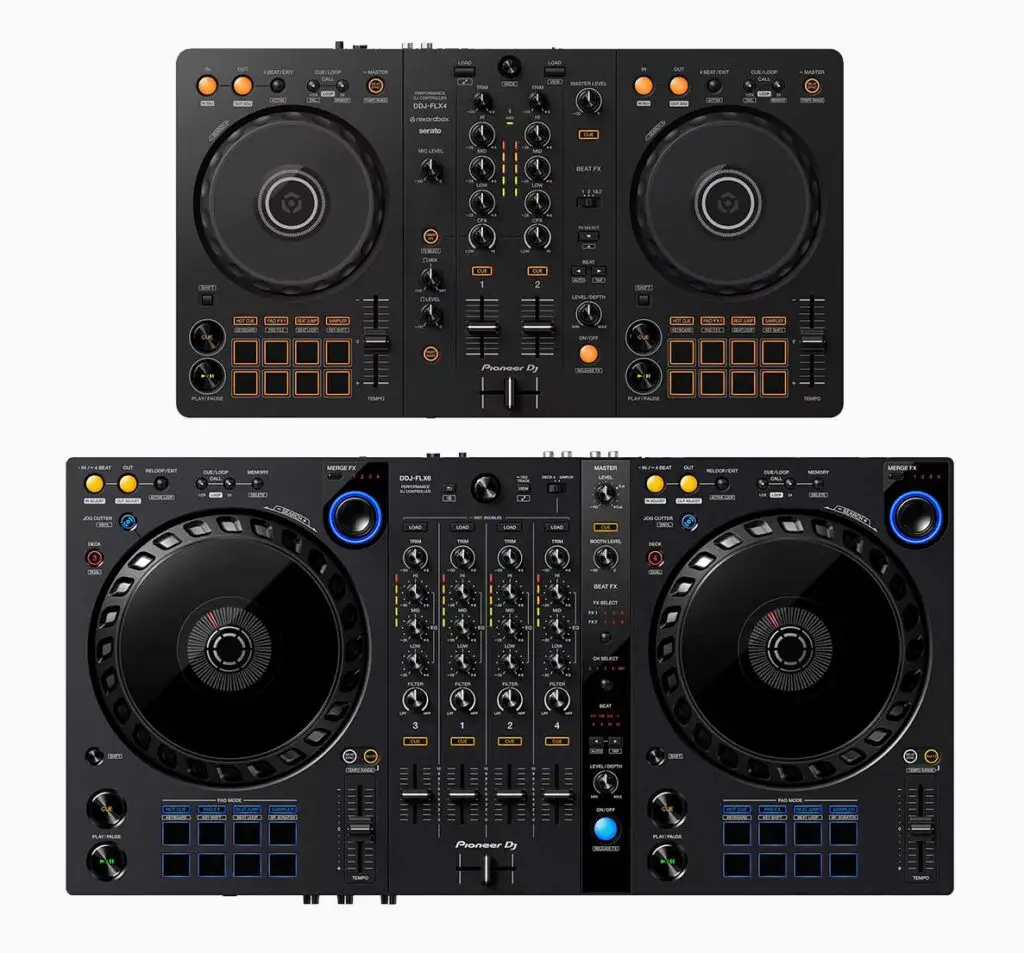
The Pioneer DDJ-FLX6, despite having a larger digit at the end of its name, is an older device released back in 2020. In essence, its main advantages are 4 mixer channels, larger capacitive jog wheels and two exclusive features – the Merge FX and the Jog Cutter.
Other than that, the functionality of the controller layouts is largely the same on both devices despite their difference in size. Their build quality is also quite interestingly very similar.
You can read much more about the Pioneer DDJ-FLX6 and all its features (and gimmicks) here: Pioneer DDJ-FLX6 – DJ Controller Overview
Pioneer DDJ-Rev1 vs. DDJ-SB3
Well, first of all it’s important to note that the Pioneer DDJ-SB3 has been discontinued back in 2022, and there aren’t many new units left on the market.
The Pioneer DDJ-Rev1 is supposed to be the direct replacement for the SB3, updated with the mentioned battle-style control layout. It follows the same path of being a dedicated Serato DJ controller and having its features geared more towards beginner scratch DJs.
Overall, the SB3, while being an outdated DJ controller, still can be a fairly good option for you if you’re able to find it somewhere on the second-hand market for a good price. With that said, it won’t feature either the battle-style DJ controller layout or the newer features present on the Rev1 such as the FX paddles or the larger, more convenient jog wheels.
If you’re positive that you’d like to go the DDJ-SB3 route, you can still get it used for a good price, for example here, over on Ebay.
The conclusion – which one should you choose?
So, in the end, which one of these is a better choice for you? Well, as I’ve mentioned, it all boils down to whether you want a newer entry-level device with the more popular club control layout, more features and support for both Serato DJ and Rekordbox DJ software – the Pioneer DDJ-FLX4, or an entry-level DJ controller geared more towards beginner scratch DJs, with FX paddles, a bit larger jog wheels and no support for Rekordbox – the Pioneer DDJ-Rev1.
Keep in mind that both the Pioneer DDJ-Rev1 and DDJ-FLX4 have some functionality limited when you use Serato DJ Lite instead of doing the paid upgrade to Serato DJ Pro. If you go the Rekordbox route with the FLX4, you can control Performance mode without a paid subscription thanks to Hardware Unlock, although some additional Rekordbox features still require a paid plan.
Ultimately, the choice between these two should be dictated either by your preferences when it comes to the control layout, the sentiment towards the scratch DJ related functions of the Rev1, or towards the more extensive feature set present on the DDJ-FLX4.
In the end, if I compare these devices in terms of which one simply enables you to do more and gives you more creative freedom, the Pioneer DDJ-FLX4 would come off as a better choice.