

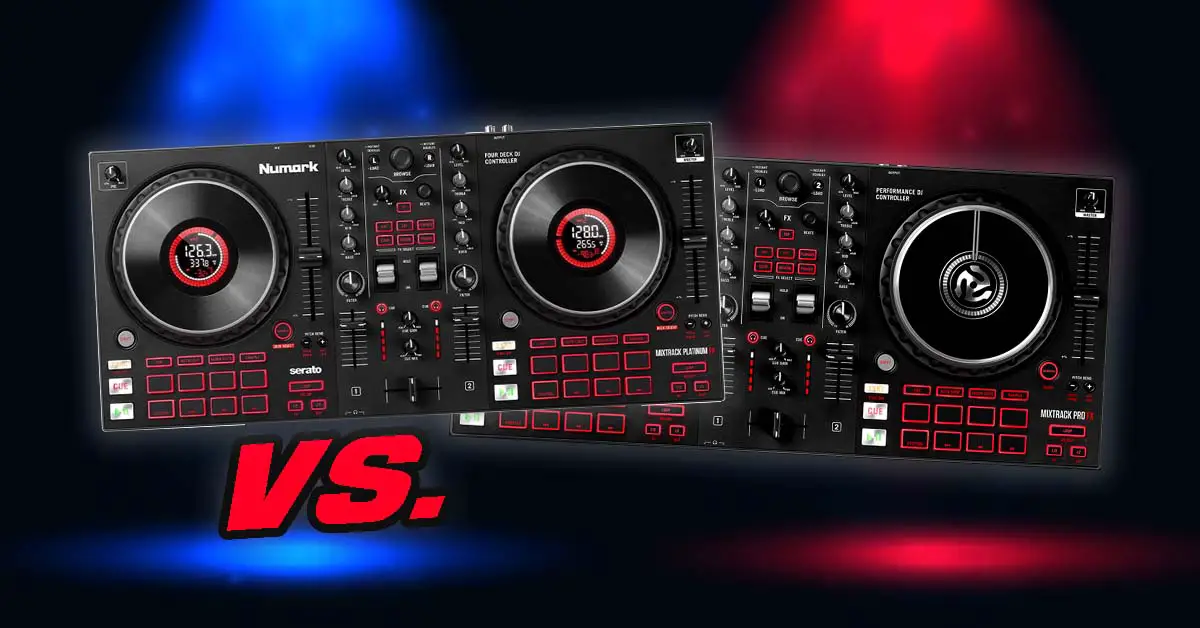
Numark Mixtrack Pro FX and the Numark Mixtrack Platinum FX are two closely related entry-level Serato DJ controllers. Let’s compare their main differences and similarities to help you decide which one is better for you.
This web portal is reader-supported and is part of the AliExpress Partner Program, Amazon Services LLC Associates Program, eBay Partner Network, and Guitar Center Affiliate Program. When you buy using links on our site, we may earn an affiliate commission.
Numark Mixtrack Platinum FX vs. Mixtrack Pro FX – full specification comparison
| Specs |
|---|
The main differences
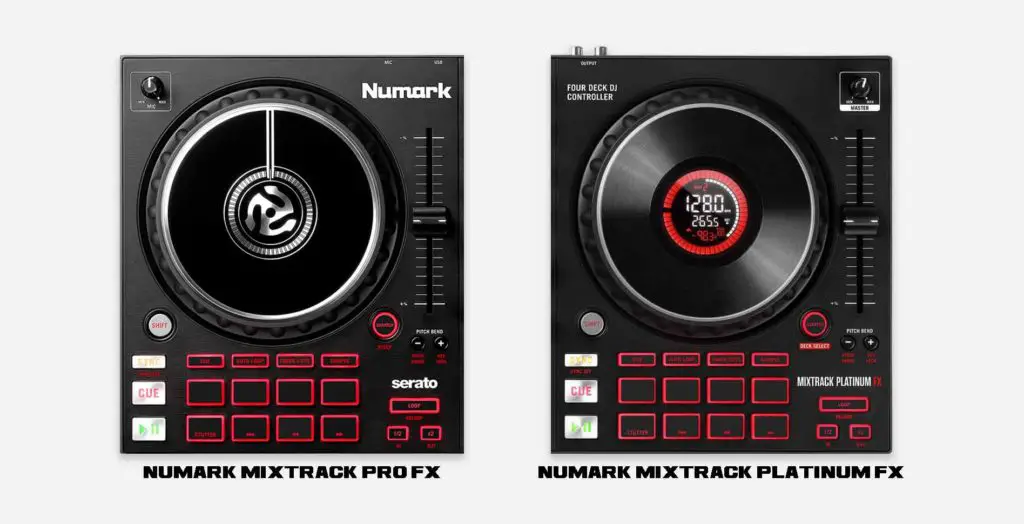
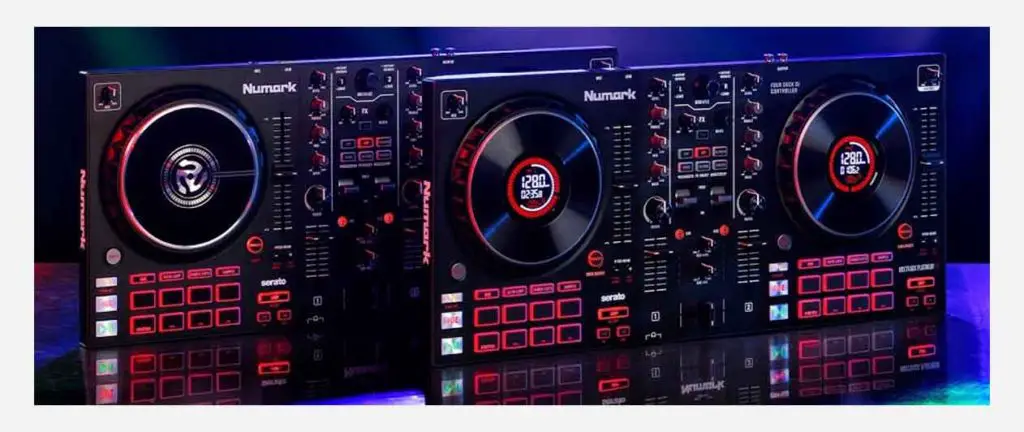
Numark Mixtrack Platinum FX and the Numark Mixtrack Pro FX actually don’t really differ that much. The main differences between the two are the jog wheel displays and the 4-deck control capability on the Mixtrack Platinum FX. Other than that these devices are made of almost exactly the same components and feature identical control scheme layouts.
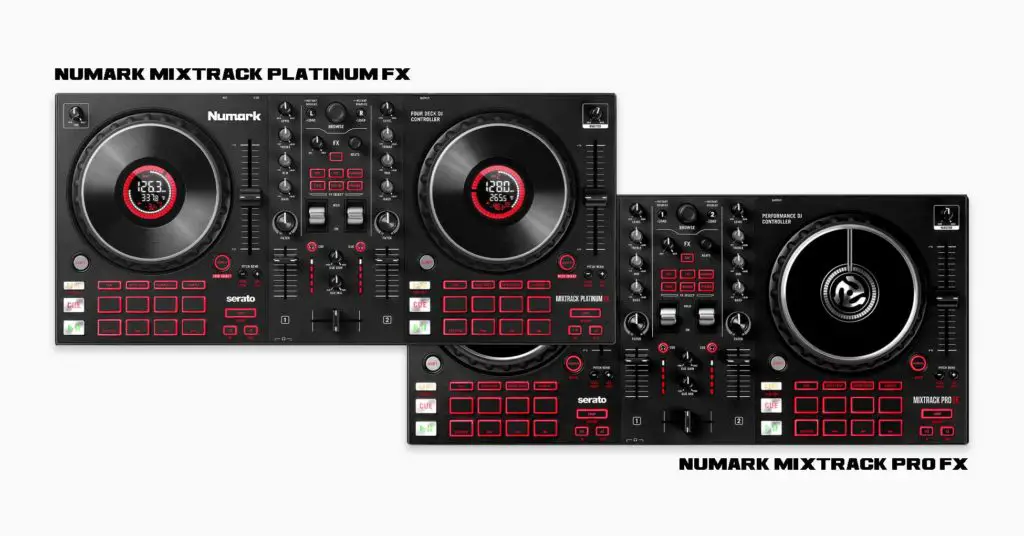
Although both devices are the same size, the Mixtrack Platinum FX is slightly lighter at 5.0 lbs (2.3 kg), compared with 5.35 lbs (2.4 kg) for the Mixtrack Pro FX. This doesn’t really make a significant difference.
Pitch faders
Numark Mixtrack Platinum FX and Mixtrack Pro FX both feature full-size pitch faders. This is a nice touch, as many entry-level DJ controllers use much shorter tempo faders, which can make precise pitch adjustments more difficult.
Another important thing to mention when it comes to the tempo faders on both of these devices is that neither of them feature a “click” on the zero position in the middle of the pitch fader. This means that it might be a little confusing at first to come back to the zero position on these if you’re used to DJ controllers featuring that reassuring click in the middle of tempo faders.
Performance pads
There are no significant differences in terms of performance pads or performance pad modes between the Numark Mixtrack Platinum FX and the Numark Mixtrack Pro FX. Both devices feature the exact same pad modes and the pads themselves seem to be the exact same reused components.
A big upside of the performance pads on these devices is that they don’t make the “click” sound while being pressed down. That makes them feel very similar to performance pads you can find for example on the Pioneer DDJ-SX line of professional DJ controllers (however the size of the pads on these Numark controllers is much smaller). This also places them above the pads of DJ controllers like DDJ-400 that essentially make use of standard click activated buttons to emulate actual performance pad experience.
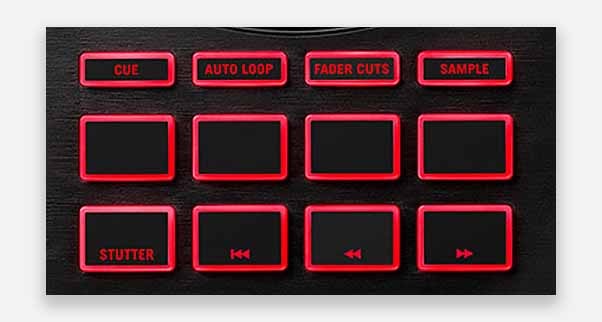
On both devices, the bottom set of 4 performance pads is used for transport controls: Stutter, Previous Track, Search Backward, and Search Forward, as indicated by the icons on the pads.
Serato DJ Lite uses the upper four pads for the main Hot Cue, Auto Loop, Fader Cuts, and Sampler functions. The Lite version is also limited to 4 Hot Cues and 4 Sampler slots.
Upgrading to Serato DJ Pro expands features such as Hot Cue and Sampler capacity and gives you access to much more of Serato’s full feature set.
If you plan to use those devices with Virtual DJ software (which they are also compatible with) you can omit those limitations. Keep in mind however that the performance pad mode functionality in Virtual DJ may differ a bit from the original dedicated feature set present in Serato DJ software.
Following performance pad modes are available on the Mixtrack Pro FX and the Mixtrack Platinum FX:
- Cue – a simple hot cue mode.
- Auto Loop – a set of one-click loops, with the four pads triggering 1, 2, 4, and 8-beat loops.
- Fader cuts – a mode that automates crossfader movement after a press of a pad to help you imitate scratching and learn common crossfader scratch patterns.
- Sample – sampler with 4 sample slots available (8 with Serato DJ Pro).
| Numark Mixtrack Pro FX on Ebay: |
| Numark Mixtrack Platinum FX on Ebay: |
Fader cuts pad mode
The fader cuts pad mode is available on both the Numark Mixtrack Platinum FX and the Numark Mixtrack Pro FX.
When you press and hold down one of the performance pads in the fader cuts mode, your crossfader movement will be automated in a way that resembles most common crossfader movements used during scratching. All that’s left for you to do is load a scratch sample onto one of the decks, move the platter, and try to recreate the automated crossfader movements.
You have access to 4 automated fader cuts with Serato DJ Lite and to 8 in total after a paid upgrade to Serato DJ Pro.
This feature seems to be mostly a gimmick already known from devices such as the Pioneer DDJ-SB3 (pad scratch feature), or the DDJ-FLX6 (jog cutter mode). While it could be somewhat beneficial for beginners to practice using the “call and response” method to learn the proper crossfader movements used during scratching, a simple loop roll or pad FX mode would be a much better choice here.
Pioneer DDJ-FLX6 – DJ Controller Overview
Audio FX controls
The audio FX controls on both of the devices are identical. They consist of two FX paddles that can either be activated momentarily after being flicked down, or lock in place after being flicked up. Those very paddle switches seem to be taken straight from the Numark Scratch line of mixers and retain the same high quality on both the Mixtrack Pro FX and the Mixtrack Platinum FX.
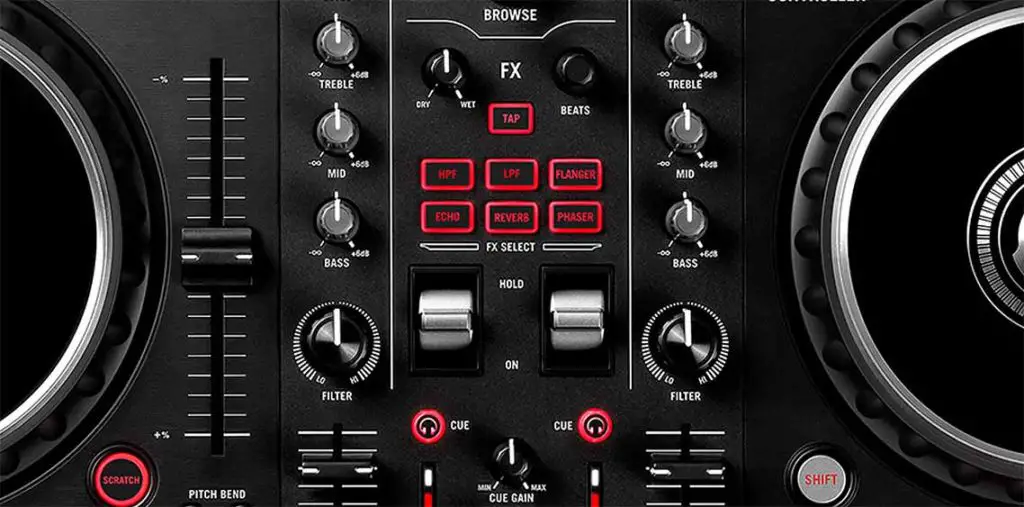
It’s really nice to see paddle FX controls on more entry level controllers, as many DJs prefer this type of FX activation method rather than a simple button activated effector or a single Beat FX strip.
If you’re interested in an affordable entry-level DJ controller that makes use of fully customizable paddle FX you should definitely check out the Pioneer DDJ-Rev1.
The six dedicated FX buttons give you quick access to the effects labeled on the controller: HPF, LPF, Flanger, Echo, Reverb, and Phaser. Current versions of Serato DJ also support Channel FX on both Mixtrack FX models.
Jog wheels
Both devices feature 6-inch capacitive-touch jog wheels. The main difference is that the Mixtrack Platinum FX has built-in jog wheel displays, while the Mixtrack Pro FX uses a simple physical platter-position marker.
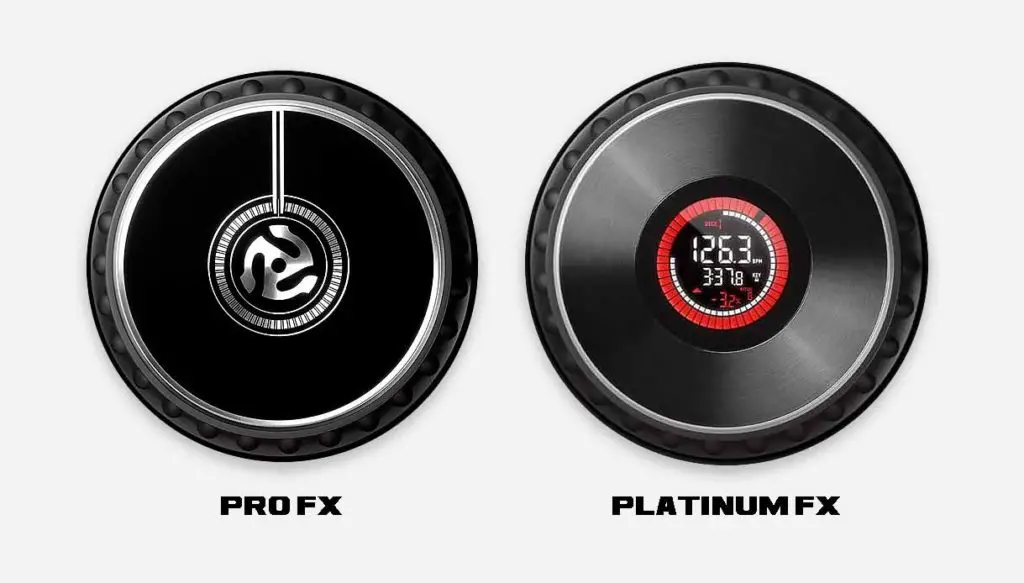
On the Numark Mixtrack Platinum FX, you have access to two small displays placed on top of the jog wheels, displays that you can use to monitor the virtual needle position, track BPM, track timestamp, current tempo change percentage and so on.
Although the Mixtrack Pro FX doesn’t feature any kind of displays on top of its jog wheels, it has a nifty needle indicator on each of the platters. This is still a nice touch.
4 deck mixing on the Mixtrack Platinum FX
Numark Mixtrack Platinum FX enables you to use the virtual decks 3 and 4 to imitate mixing on 4 decks by pressing the appropriate button on the device. This way you can play up to 4 tracks at the same time and attempt to mix them together.
Having 4-deck control is useful, but remember that the Mixtrack Platinum FX still has only two physical mixer channels. Decks 1 and 3 share one side of the controller, while decks 2 and 4 share the other, so controlling four tracks is less direct than it would be on a true 4-channel controller. You also have to pay attention to cases where a physical fader’s position doesn’t match the software position after switching deck layers.
On the Mixtrack Pro FX you can only use up to 2 decks and you have no way to access virtual decks 3 and 4.
Inputs and outputs
Numark Mixtrack Pro FX and the Numark Mixtrack Platinum FX feature the exact same inputs and outputs. Here is the list of those:
| Inputs: | 1x 1/4″ (6.35 mm) TS jack (microphone input) |
| Outputs: | 1x RCA master output 1x 1/4″ (6.35 mm) TRS jack (headphone output) 1x 1/8″ (3.5 mm) TRS jack (headphone output) |
| Other: | 1x USB (for computer connection and power) |
The two devices are powered solely via USB connection and don’t require any kind of additional power supply.
Software compatibility
Both the Mixtrack Pro FX and Mixtrack Platinum FX are officially supported by Serato DJ Lite and Serato DJ Pro. Serato DJ Lite is included for free, while Serato DJ Pro is available as a paid upgrade and gives you access to the full Serato feature set, including expanded Hot Cue and Sampler capacity, mix recording, and more advanced performance features.
Both controllers are also officially supported by VirtualDJ. To use either controller with VirtualDJ, you’ll need a Pro Infinity, Pro Subscription, or the appropriate controller-specific Plus license.
If you’re unsure whether the Serato DJ Pro upgrade is worth it, I’ve compared Serato DJ Lite and Pro in detail here.
The Conclusion – are these controllers any good?
Both the Numark Mixtrack Pro FX and Mixtrack Platinum FX are capable entry-level DJ controllers, and there really aren’t many major differences between them aside from the few details that we’ve discussed here. The main additions on the Platinum FX are the jog wheel displays and access to layered 4-deck control.
If you don’t care about either of those features, the Mixtrack Pro FX gives you essentially the same core mixing, pad, and FX workflow. If you’re also considering alternatives from Pioneer DJ, the DDJ-FLX4 and DDJ-REV1 are much more relevant current options. I’ve compared those two directly here: DDJ-FLX4 vs. DDJ-REV1 comparison