

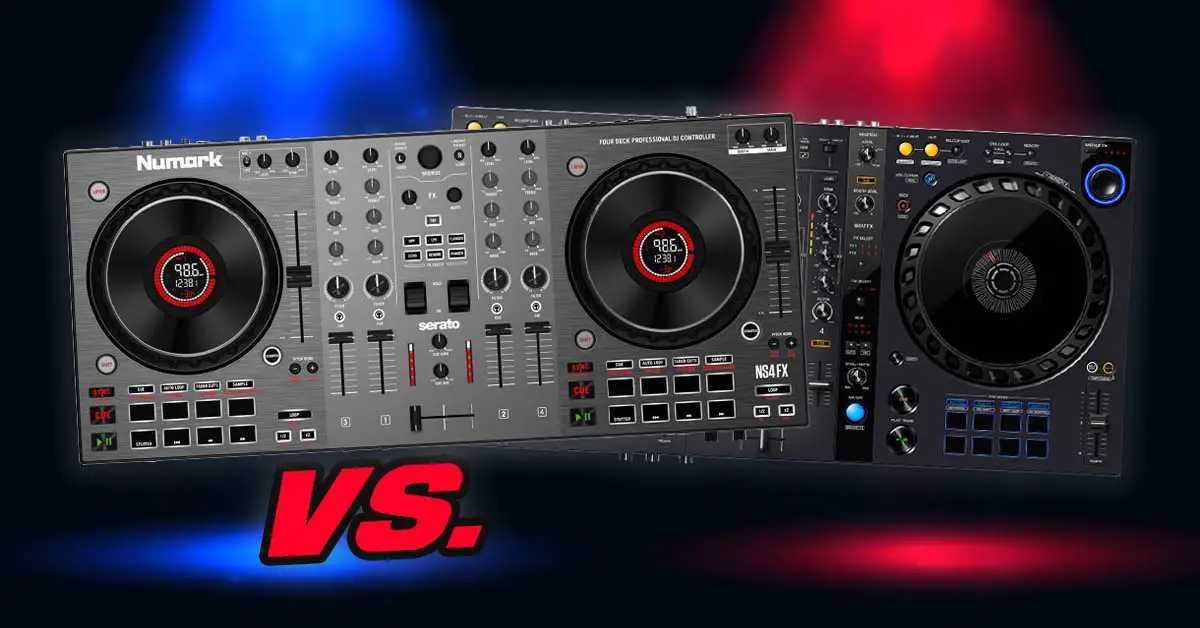
Pioneer DDJ-FLX6 vs. Numark NS4FX – straight to the point 4-channel DJ controller comparison. The NS4FX is still a current Numark model, while the original DDJ-FLX6 was replaced by the DDJ-FLX6-GT. Still, if you’re choosing between the NS4FX and an original FLX6, there are some pretty important differences between the two.
This web portal is reader-supported and is part of the AliExpress Partner Program, Amazon Services LLC Associates Program, eBay Partner Network, and Guitar Center Affiliate Program. When you buy using links on our site, we may earn an affiliate commission.
Numark NS4FX vs. Pioneer DDJ-FLX6 – full specification comparison
| Specs |
|---|
Mixer sections comparison
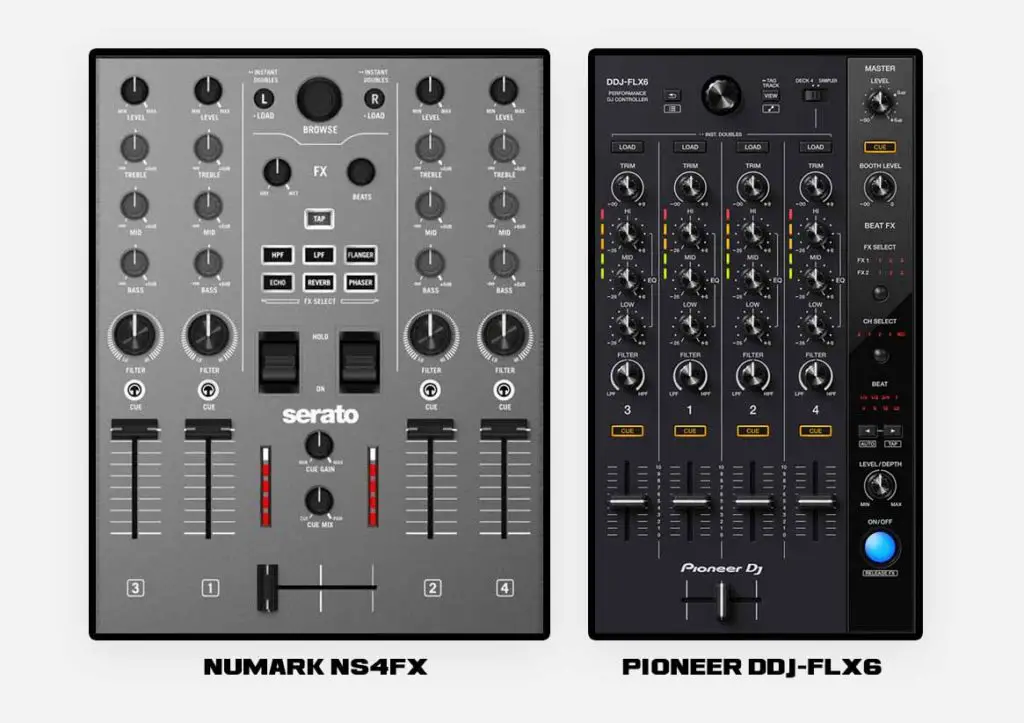
Both units let you control 4 decks using the 4 mixer channels and deck switch buttons present on each deck.
In terms of the mixer section the only major difference here is the control layout that follows the different way both these devices handle audio FX.
On the Pioneer DDJ-FLX6, the FX section is placed on the right side of the mixer, somewhat resembling a classic Beat FX strip found on Pioneer DJM mixers. The Numark NS4FX instead places its FX controls and paddles in the middle of the mixer.
When it comes to mixer section functionality these devices are pretty much the same, however:
- The Pioneer DDJ-FLX6 has a separate level meter for each mixer channel, while the Numark NS4FX has two deck level meters that follow the currently selected deck layer on each side.
- Pioneer DDJ-FLX6 has a track load button for each mixer channel, when the Numark NS4FX has only 2 L/R deck load buttons (to load tracks to decks 3/4 you have to activate these decks first using the deck switch controls).
- Also, on the Numark NS4FX the channel filter knobs are a little bigger than on the DDJ-FLX6, that however is purely a cosmetic difference.
- On the NS4FX without the upgrade to Serato DJ Pro, you are not able to access the 4 waveform view where all of your 4 track waveforms are displayed on the screen at once, using other kind of DJ software with the controller mitigates this issue.
Another noticeable difference is that the Numark NS4FX has long pitch faders, while the DDJ-FLX6 uses much shorter tempo faders similar to those found on smaller entry-level controllers.
The crossfaders
In terms of the crossfader quality and cutting distance there are no miracles on each side here. The crossfaders on both devices are good quality and will do for mixing and light scratching but don’t expect the Magvel quality from any of these units.
FX sections
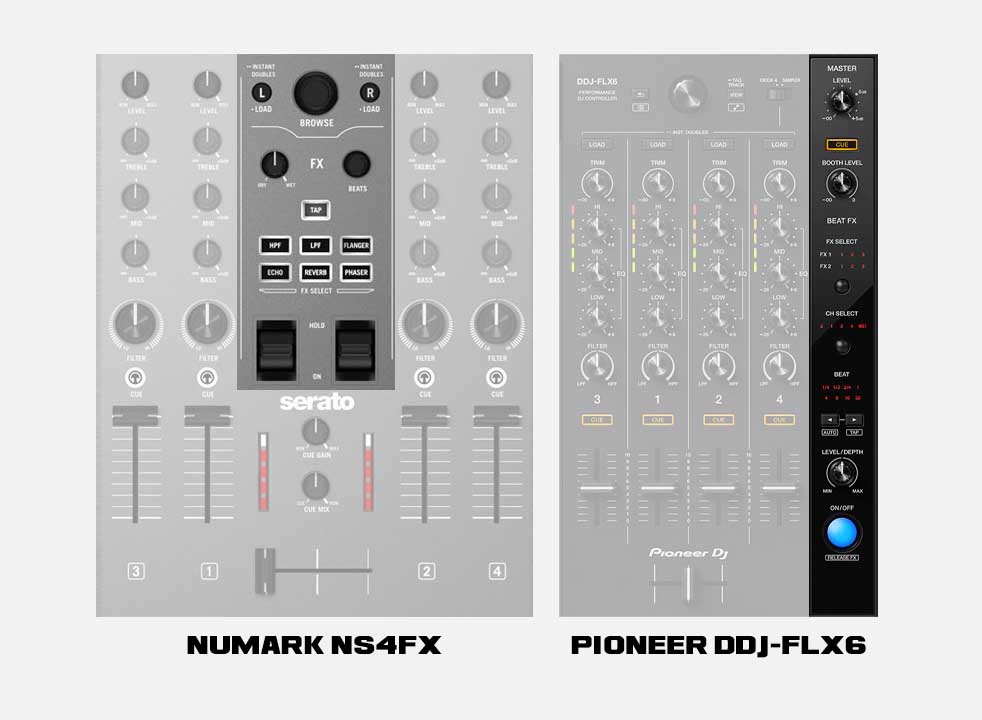
The FX sections on both devices are very different. On the Numark NS4FX you are presented with an FX section featuring two FX paddles which when pressed down trigger a chosen FX momentarily, and when pushed up lock in place.
Numark NS4FX has access to 6 base software FX you can choose from: the high pass filter, low pass filter, flanger, echo, reverb and a phaser.
There are also some additional FX controls here: a dry/wet parameter knob, beat division adjustment knob and a tap button.
On the Pioneer DDJ-FLX6 you can make use of 6 chosen software FX and have access to following additional FX controls: level/depth (dry/wet) parameter knob, FX channel select button, beat division adjustment button and tap button accessible by using the shift button.
An important thing to mention is that on the Pioneer DDJ-FLX6 (when using it with Rekordbox or VirtualDJ software) you also have access to customizable Pad FX – custom effects triggered momentarily by pressing down on performance pads when the Pad FX mode is active.
A major disadvantage of the effects section on the DDJ-FLX6 is the lack of beat parameter and FX select knobs – instead you are presented with simple push buttons and that means that you have to cycle through all the beat divisions / all the FX to get to the one you want to choose.
You might also like: Numark Mixtrack Platinum FX vs. Pro FX (Which One Is better?)
Merge FX on the DDJ-FLX6
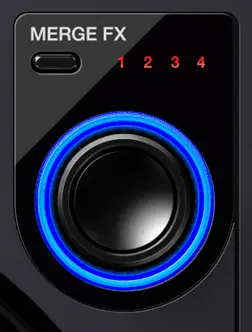
Besides its regular FX section and the FX accessible via the Pad FX performance pad mode, the Pioneer DDJ-FLX6 also features two big Merge FX knobs – one for each deck.
Merge FX is one of the DDJ-FLX6’s signature features. It helps you perform transitions between tracks vastly differing in tempo by letting you choose from 8 transition FX presets – automated FX, loop and sample macro patterns activated by pressing and turning the Merge FX knob.
When you’re using your Pioneer DDJ-FLX6 with Serato DJ Pro you have access to just 4 Merge FX presets with little to no customization. With Rekordbox you can utilize up to 8 Merge FX presets which can be fully customized with your own FX macros and audio samples.
More on the Merge FX mode exclusive to the Pioneer DDJ-FLX6 in my DDJ-FLX6 overview here.
Performance pads + pad modes
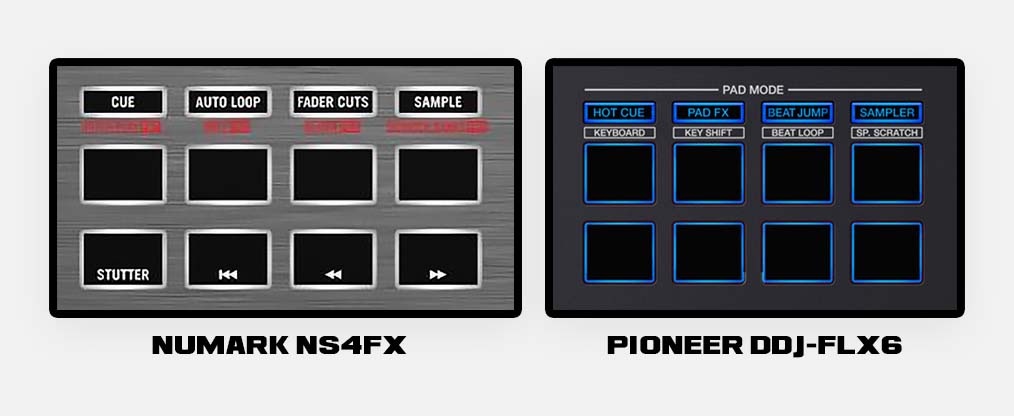
Both units feature 8 performance pads. Here are the main pad modes available on the NS4FX and DDJ-FLX6.
You can find the following performance pad modes on the Numark NS4FX:
- Cue – Access to 4 hot cue slots (8 slots with Serato DJ Pro upgrade).
- Auto Loop – Standard one-tap loop presets (with Serato DJ Lite access to only 1-8 beat loops – there is no access to half beat loops or loops longer than 8 beats with Serato DJ Lite).
- Fader Cuts – Numark’s semi-automatic scratch pad mode, described in the next section.
- Sample – Simple 4 slot sampler (8 slots available with Serato DJ Pro).
- Pitch Play – Pad mode allowing you to play with the pitch of selected points in the track (available only with Serato DJ Pro and the Pitch ‘N Time expansion pack) – this pad mode is the equivalent of the Keyboard mode on the DDJ-FLX6.
- Roll – Standard loop roll functionality – one tap momentary loop presets (only with Serato DJ Pro).
- Slicer – Automatically slices your track into individual bars live and allows for creative mashups (only with Serato DJ Pro).
- Scratch Bank – Access to Serato Scratch Bank functionality, you are able to save up to 4 tracks or scratch samples and trigger them using your performance pads and then quickly return to your main track with a press of a button (8 slots available with Serato DJ Pro).
On the Numark NS4FX with Serato DJ Lite the bottom 4 pads will have the same transport control functions regardless of the pad mode selected:
- Stutter – Plays your track from its beginning.
- Go Back To The Start – Places the virtual needle on the first beat of your track.
- Move Track Backwards – Rewinds your track.
- Move Track Forwards – Moves your track forwards.
Pioneer DDJ-FLX6 features the following performance pad modes:
- Hot Cue – 8 standard hot cue points.
- Pad FX – When used with Rekordbox software it gives you access to fully customizable FX triggered momentarily using the pads.
- Beat Jump – Allows you to jump through a track a selected number of beats.
- Sampler – Access to sampler slots.
- Keyboard – Allows you to control the pitch of selected points in the track.
- Key Shift – Audio pitch shifting functionality.
- Beat Loop – Same as Auto Loop – different length loop presets.
- Sp. Scratch – Access to Serato Scratch Bank (Rekordbox software has its equivalent to this feature).
Both controllers can now control Serato Stems from their performance pads. The NS4FX supports Serato’s pad-mode replacement for Stems in both Serato DJ Lite and Pro, while the DDJ-FLX6 supports it in Serato DJ Pro.
As you may have noticed, on the Numark NS4FX some of the hardware features are soft-locked without the paid upgrade to Serato DJ Pro.
The DDJ-FLX6 is a Hardware Unlock device for both Rekordbox and Serato DJ Pro, so you don’t need a separate Serato DJ Pro license while the controller is connected. New FLX6 units originally also included vouchers for Serato Pitch ‘n Time DJ and the Serato FX Pack. If you’re buying one used, however, don’t assume those vouchers are still available or unused.
The NS4FX unlocks Serato DJ Lite and requires a paid Serato DJ Pro upgrade if you want the full Pro feature set. You can read more about the differences in my Serato DJ Lite vs. Pro comparison here.
To top it all off, the Pitch Play pad mode on the NS4FX, requires you to not only upgrade to Serato DJ Pro, but also do another purchase – for the pitch play feature to work you have to additionally own the Serato Pitch ‘N Time expansion pack.
Another noticeable difference is the performance pads backlight. Pioneer DDJ-FLX6 features bright blue pad backlight, pads on the Numark NS4FX on the other hand have white LED backlight which can be too dim for some when mixing outdoors or in bright sunlight.
Fader Cuts on the NS4FX / Jog Cutter on the FLX6
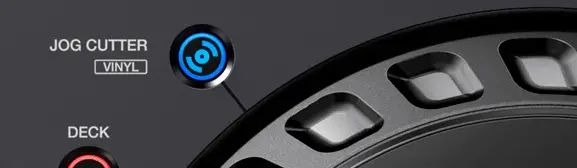
Both Numark NS4FX and the Pioneer DDJ-FLX6 offer their own scratch automation features. The NS4FX features the Fader Cuts performance pad mode and the Pioneer DDJ-FLX6 – Jog Cutter functionality.
Fader Cuts pad mode on the Numark NS4FX is a performance pad mode that allows you to use 8 different crossfader cut patterns (4 in Serato DJ Lite) that you can activate by pressing and holding down one of the pads when this mode is active.
When you press down on a pad and move your jog wheel, a certain crossfader movement pattern will be applied and you will be able to imitate scratching by just moving your jog wheel, without touching your crossfader. This can come in handy if you enjoy learning through template-response patterns.
The jog cutter feature on the Pioneer DDJ-FLX6 is activated using a dedicated button located on each deck. When this mode is active, every movement of your jog wheel will imitate a certain scratch pattern on your currently loaded track. The type of the scratch that will be triggered depends on the needle indicator position on the platter.
Both of these features are simple scratch automation gimmicks, and in my opinion there is no reason to choose one controller over the other based on these features alone. The Fader Cuts mode on the Numark NS4FX seems to be a tad more reliable if you’d like to use it for scratching practice.
| Numark NS4FX on Ebay: |
| Pioneer DDJ-FLX6 on Ebay: |
Jog wheels comparison
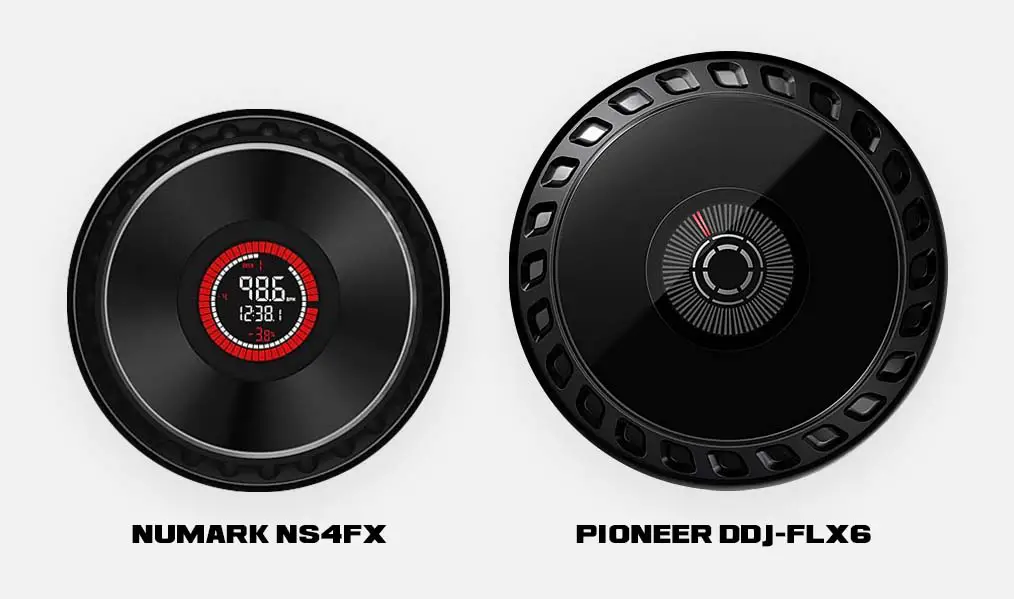
Both the Numark NS4FX and the Pioneer DDJ-FLX6 feature high quality capacitive jog wheels. The main differences between these jog wheels are the platter size and built in displays.
Numark NS4FX has two 6 inch Jog Wheels on board (~15.24 cm). These jog wheels feature in-built displays that can show the basic track information, needle position, track timing info and so on. This is a slight advantage over the FLX6.
The Pioneer DDJ-FLX6 on the other hand features two full-sized jog wheels (8.11 inches / 20.6 cm in diameter), much bigger than these on the NS4FX. In terms of size these are the same as the platters present on the DDJ-1000.
Jog wheel displays on the DDJ-FLX6 are not able to display anything but a simple LED needle position indicator.
It is also important to note that while the jog wheels on the DDJ-FLX6 might be visually similar to these present on devices like Pioneer DDJ-1000 or the Pioneer CDJ-2000/3000, the jog wheels on the DDJ-FLX6 are not mechanical like the ones present on these devices. Despite the size and appearance in terms of technology they are more or less the same capacitive jog wheels that you can find on the NS4FX.
Inputs and outputs
Here is a quick comparison of the inputs and outputs on the Numark NS4FX and the Pioneer DDJ-FLX6.
Numark NS4FX:
| Inputs: | – 1x Stereo Input (RCA) – 2x Microphone (1/4-inch jack) |
| Outputs: | – 1x Master (XLR) – 1x Booth (RCA) – 2x Headphones (1/4 inch Stereo Jack, 1/8 inch Stereo mini-jack) |
DDJ-FLX6:
| Inputs: | – 1x Microphone (1/4 inch TRS Jack) |
| Outputs: | – 1x Master (RCA) – 1x Booth (RCA) – 2x Headphones (1/4 inch Stereo Jack, 1/8 inch Stereo mini-jack) |
Note that the Pioneer DDJ-FLX6 does not feature XLR master outputs or a second additional microphone input.
One useful feature of the Numark NS4FX is that its Main output, Aux input and both microphone inputs can be sent back to your computer for livestreaming, which isn’t the case with the DDJ-FLX6.
The DDJ-FLX6 microphone input is mixed directly into its Master output and isn’t sent back to the computer over USB, so the NS4FX is much easier to use if you want microphone audio included in a computer-based livestream.
In terms of power supply, the Numark NS4FX requires a power brick (that comes with your controller), and it cannot be powered by the USB bus power alone.
The Pioneer DDJ-FLX6 on the other hand is powered solely via the USB connection.
Software compatibility
The Numark NS4FX unlocks Serato DJ Lite and can be upgraded to Serato DJ Pro. It’s also officially supported by VirtualDJ and Algoriddim djay.
The Pioneer DDJ-FLX6 is a Hardware Unlock device for Rekordbox and Serato DJ Pro. It also supports VirtualDJ, TRAKTOR PRO 3 through the official mapping file, and djay on supported platforms.
So the FLX6 still has the broader software options out of the box, particularly because Rekordbox and Serato DJ Pro don’t require separate software licenses while it’s connected.
The conclusion – which one should you get?
The Numark NS4FX and Pioneer DDJ-FLX6 are both capable 4-channel controllers, but their strongest points are quite different. The NS4FX gives you long pitch faders, balanced XLR master outputs, two microphone inputs, more useful jog displays and convenient paddle FX. The DDJ-FLX6 gives you much larger jog wheels, Rekordbox and Serato DJ Pro Hardware Unlock, Merge FX and Jog Cutter, but its audio connectivity is much more basic.
If you’re buying an FLX6 today, the price matters a lot. The original model was replaced by the FLX6-GT, and the newer DDJ-GRV6 is now a much more current 4-channel option from AlphaTheta. A used FLX6 can still make plenty of sense if you find one at the right price.
You can also check out my DDJ-GRV6 vs. DDJ-FLX6 comparison here.
