

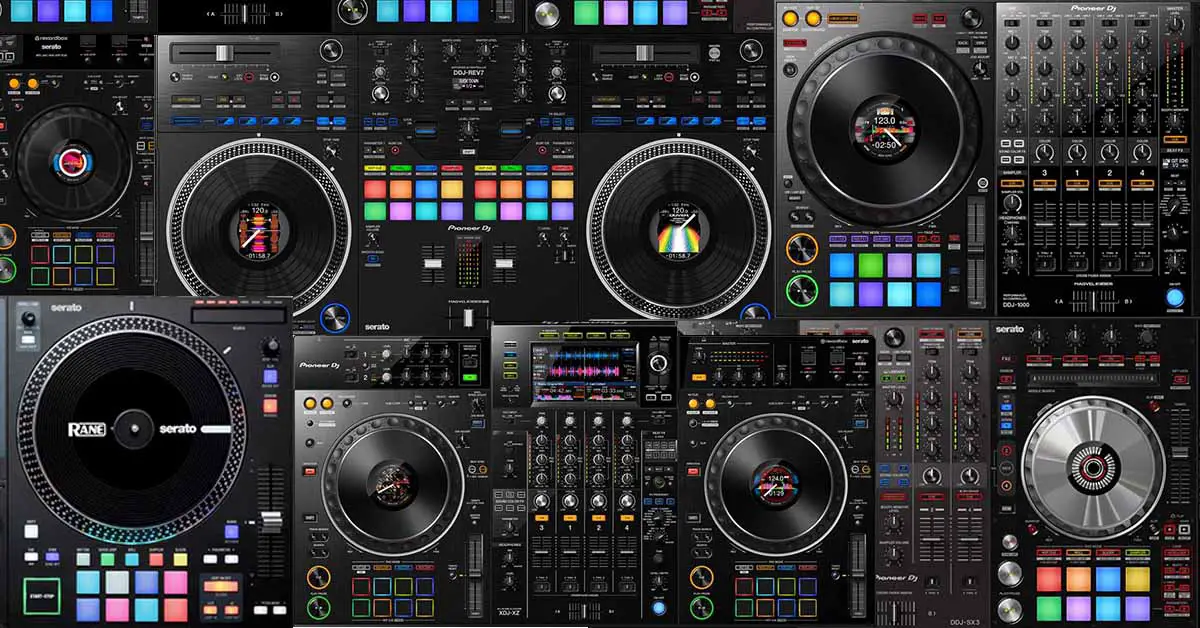
If you want one straight answer, the AlphaTheta DDJ-GRV6 is probably the best DJ controller for most people buying new this year. It gives you four-channel control, large jog wheels, a familiar club-style layout, and support for both Rekordbox and Serato without jumping straight to the DDJ-FLX10 price tier.
That recommendation changes with the job you want the controller to be able to do. The Pioneer DDJ-FLX4 is still one of the best budget picks for beginners. The Denon DJ Prime 4+ gives you pretty much the best standalone feature set for the lowest price, while the AlphaTheta XDJ-AZ (the successor to the XDJ-XZ) is the better choice if you want a full-size club-style standalone system in the AlphaTheta ecosystem. Scratch DJs now have two very different worthwhile Rane options to look at, and those are the laptop-based Rane ONE MKII and the standalone Rane System One.
This guide covers controllers and all-in-one DJ systems that you can get new as of the time of writing. The DDJ-1000, DDJ-SX3, DDJ-800, XDJ-XZ, DDJ-FLX6, and other discontinued models are not included here.
This web portal is reader-supported and is part of the AliExpress Partner Program, Amazon Services LLC Associates Program, eBay Partner Network, and Guitar Center Affiliate Program. When you buy using links on our site, we may earn an affiliate commission.
My Selection Criteria – In Short
For each of the devices here I take into account the current manufacturer and software support, retail availability, input and output options for both club and bedroom practice purposes, deck control, jog wheels, portability, and how much of each controller you can actually use without paying for extra software, which as you might already know is a large part of choosing one ecosystem over another. With that said, let’s move on.
If you want to look at more options right away, you can also browse our DJ Gear Database where you can compare different models and their specifications directly.
1. AlphaTheta DDJ-GRV6 – Best For Most DJs
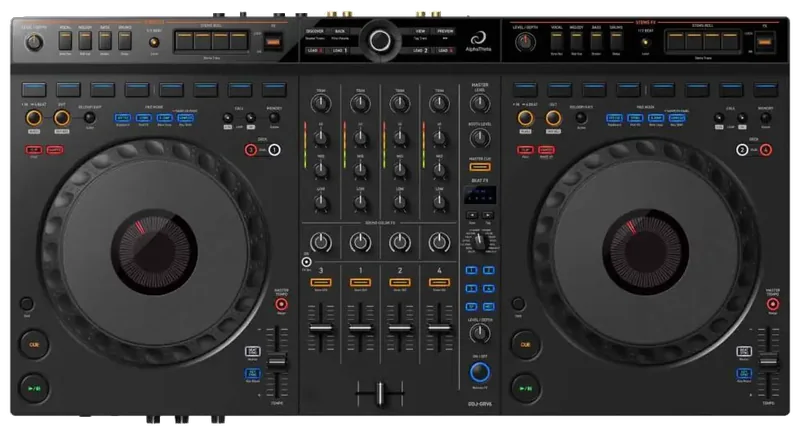
Four-channel laptop DJ controller with full-size jog wheels, a club-style layout, Groove Circuit controls, and support for Rekordbox, Serato DJ Pro, and djay Pro.
- Large jog wheels and a familiar club-style layout.
- Four-channel control without flagship pricing.
- Works with Rekordbox, Serato DJ Pro, and djay Pro.
- No external deck inputs or standalone mixer mode.
- No XLR output, and the booth output is RCA.
- Groove Circuit changes function outside Rekordbox.
| Type | Four-channel software DJ controller |
| Deck Control | Four decks / dual-deck control |
| Jog Wheels | 206 mm full-size touch-sensitive jog wheels |
| Performance Pads | Eight pads per deck |
| Software | Rekordbox, Serato DJ Pro, djay Pro |
| Standalone Use | No – computer or supported mobile device required |
| Microphone Input | 1 x 1/4-inch TRS |
| Master Outputs | 1/4-inch TRS stereo pair + RCA stereo pair |
| Booth Output | RCA stereo pair |
| USB | 2 x USB-C |
| Dimensions | 711.4 x 375.9 x 75.7 mm / 28.0 x 14.8 x 3.0 in |
| Weight | 4.6 kg / 10.2 lb |
The DDJ-GRV6 is in my eyes a rather easy first recommendation for those of you who have moved past entry-level gear but don’t really need the extra connections and hardware features of the DDJ-FLX10. The jog wheels are full-size, the performance pads sit above them in the current AlphaTheta club layout reminiscent of the CDJ-style players, and four-deck controls are a neat bonus.
Groove Circuit is the headline feature in Rekordbox, and one of the main selling points of this controller according to AlphaTheta. It lets you swap and manipulate drum parts without reaching for the laptop. In Serato DJ Pro, the same hardware area controls Stems FX instead, so the workflow depends on the software you use. This is a common theme with devices that can control both Serato & Rekordbox.
The main compromise is on the back panel. There are no line or phono inputs for external decks, no standalone mixer mode, no XLR master output, and only an RCA booth output available. If you need to connect turntables, hand over between two laptops, control DMX lighting, or run a more complete mobile setup, the DDJ-FLX10 listed down below is worth the extra money.
You can see how the GRV6 compares to the older and much simpler DDJ-FLX6 here: AlphaTheta DDJ-GRV6 vs. Pioneer DDJ-FLX6
2. Pioneer DDJ-FLX4 – Best Beginner DJ Controller
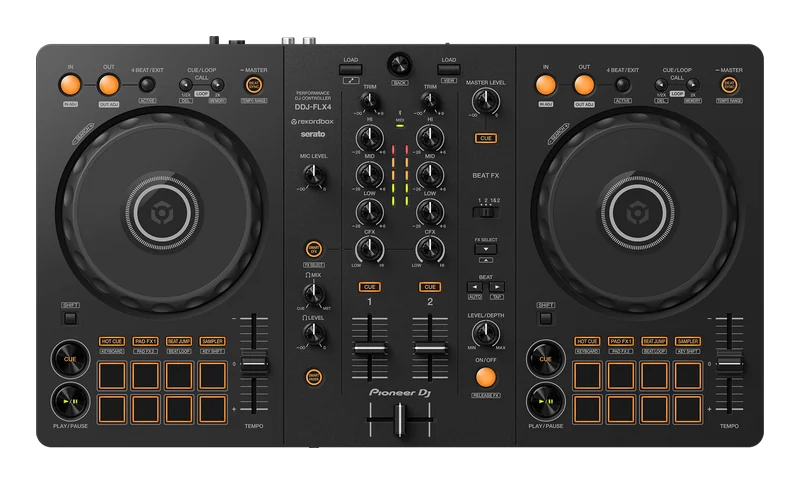
Compact two-channel controller for learning on a laptop, phone, or tablet, with a standard club-style layout and broad software support.
- Clear layout that is easy to learn and grow with.
- Works with several desktop and mobile DJ apps.
- Light, USB powered, and easy to carry.
- RCA master output with no separate booth output.
- Short pitch faders limit fine tempo adjustments.
- Two channels and basic connections leave little room for expansion.
| Type | Two-channel software DJ controller |
| Deck Control | Two decks |
| Performance Pads | Eight pads per deck |
| Software | Rekordbox, Serato DJ Lite, Serato DJ Pro with paid license, djay Pro, Traktor Play |
| Mobile Support | Compatible with supported iOS and Android DJ apps |
| Standalone Use | No – computer or supported mobile device required |
| Microphone Input | 1 x 1/4-inch TS |
| Master Output | RCA stereo pair |
| Booth Output | None |
| USB | 2 x USB-C |
| Power | USB bus powered |
| Dimensions | 482.0 x 272.8 x 59.2 mm / 19.0 x 10.7 x 2.3 in |
| Weight | 2.1 kg / 4.6 lb |
The DDJ-FLX4, which is the direct successor to the Pioneer DDJ-400, is still one of the safest smaller beginner-friendly controllers to buy. The deck and mixer layout teaches the controls you will see on larger Pioneer DJ and AlphaTheta systems, while Smart Fader and Smart CFX can help a new DJ get through early mixes without hiding the standard controls.
In short, a great nearly-portable DJ controller you can get without spending a fortune on more advanced gear. It also gives you more software freedom than many of the older beginner devices. Rekordbox and Serato DJ Lite are the obvious starting points, but supported versions of djay and Traktor Play give phone, tablet, and laptop users other workable routes.
The DDJ-FLX4 is still entry-level hardware. You get an RCA master output, no booth output, no external deck inputs, and small pitch faders. Those limits are fine at home and for learning, as well as connecting to many basic sound systems. Regular paid gigs are a good reason to move up to a controller with balanced outputs and a separate booth feed.
Here you can see how the FLX4 compared to the larger DDJ-FLX6: Pioneer DDJ-FLX4 vs. FLX6 – Direct Comparison
3. Pioneer DDJ-FLX10 – Best Premium Laptop DJ Controller
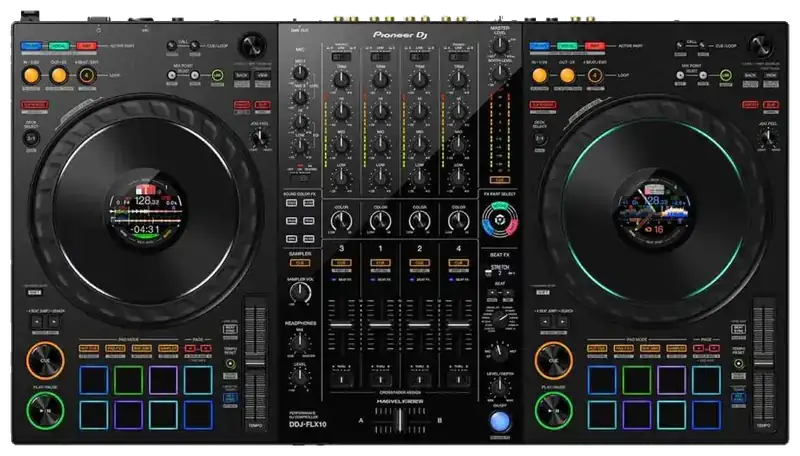
Professional four-channel controller with large mechanical jog wheels, external deck inputs, track-separation controls, dual computer connections, and built-in DMX output.
- Excellent full-size mechanical jog wheels with displays.
- Proper external inputs, balanced outputs, and dual USB-C ports.
- Strong Rekordbox and Serato integration with stem controls.
- Expensive for a controller that still needs a computer.
- Large and heavy compared with the DDJ-GRV6.
- Track separation performance depends on the computer and software.
| Type | Four-channel professional software DJ controller |
| Deck Control | Four decks / dual-deck control |
| Jog Wheels | 206 mm full-size mechanical jog wheels with On Jog Display |
| Performance Pads | Eight pads per deck |
| Software | Rekordbox, Serato DJ Pro, djay Pro |
| External Inputs | 2 x phono/line RCA |
| Microphone Inputs | 1 x XLR/TRS combo + 1 x 1/4-inch TRS |
| Master Outputs | XLR stereo pair + RCA stereo pair |
| Booth Output | 1/4-inch TRS stereo pair |
| USB | 2 x USB-C computer ports |
| Lighting Control | DMX output for Rekordbox Lighting |
| Dimensions | 716.0 x 400.3 x 73.4 mm / 28.2 x 15.8 x 2.9 in |
| Weight | 6.7 kg / 14.8 lb |
The DDJ-FLX10 is one of the best choices for a Rekordbox or Serato DJ who wants to keep a laptop at the center of the setup. If money is not an issue and you’re going all-in, I do think that taking the leap from the GRV6 straight to the FLX10 is very much worth it hardware-wise. The mechanical jog wheels feel much closer to Pioneer DJ’s full-size players than the capacitive platters on cheaper controllers, and the mixer can take external line or phono sources.
The dedicated track-separation controls are useful for live stem mixing, and Rekordbox users also get Mix Point Link and a DMX output for lighting control. Dual USB-C computer ports, XLR master outputs, and a balanced booth output make the FLX10 much easier to place in a working mobile or event rig than the DDJ-GRV6.
You are paying for those connections and extra workflows and features, as well as additional controls. DJs who only mix two decks at home can in theory leave a lot of the hardware unused, but in my eyes, if you’re really into it, you can outgrow an entry-level controller rather easily. If you’re still deciding, my vote is on the FLX10, if you’re serious about the art.
Here you can see the FLX10 compared to one of its top-shelf predecessors: Pioneer DDJ-FLX10 vs. DDJ-1000
4. Rane FOUR – Best Serato Performance Controller
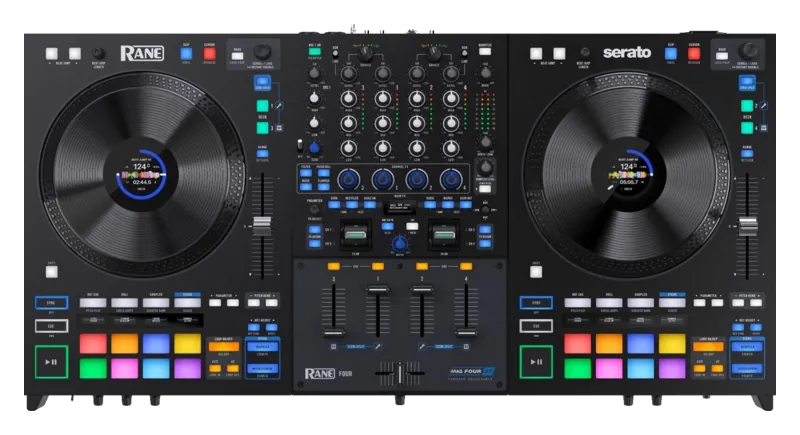
Four-channel Serato performance controller with dedicated Stems controls, Stem Split, large static jog wheels, internal effects, and a full set of professional connections.
- One of the best hardware layouts for Serato Stems.
- Stem Split can move separated parts to their own mixer channels.
- Strong internal FX and professional input/output section.
- The jog wheels are large but do not rotate.
- Much of its advantage is tied to a Serato workflow.
- Wide and heavy for regular transport.
| Type | Four-channel professional software DJ controller |
| Deck Control | Four decks / dual-deck control |
| Jog Wheels | 8.5-inch static capacitive jog wheels with displays |
| Performance Pads | Eight pads per deck with OLED mode displays |
| Software | Serato DJ Pro; VirtualDJ and djay Pro with separate licenses |
| Hardware FX | 22 internal Main FX plus channel FX controls |
| External Inputs | 2 x phono/line RCA |
| Microphone Inputs | 2 x XLR/TRS combo |
| Main Outputs | XLR stereo pair + RCA stereo pair |
| Booth / Zone Output | 1/4-inch TRS stereo pair |
| Computer Connections | 2 x USB-B |
| Dimensions | 783.3 x 402.3 x 103.6 mm / 30.84 x 15.84 x 4.08 in |
| Weight | 8.27 kg / 18.25 lb |
The Rane FOUR is built around Serato DJ Pro rather than simply adding a few stem buttons to a standard layout. You can isolate vocals or instrumentals from each deck, use Stems on the performance pads, and split a track’s instrumental and vocal parts across separate mixer channels which complements the 4-channel layout rather nicely.
Its internal effects section is another strong point. The Main FX work without relying on Serato’s effect engine, and each channel also has quick-access Filter, Filter Roll, Flanger, and Noise controls. External phono and line inputs, dual computer ports, two microphone inputs, and proper booth and main outputs cover professional setups well.
The 8.5-inch jog wheels are great, but they are static. The Rane Performer is the better four-channel choice if rotating platters are something you’d like on your controller. The Rane ONE MKII costs less and has the motorized jogs on board, although it drops to just two mixer channels.
You can take a closer look at the series here: Rane FOUR vs. Rane ONE DJ Controller Comparison
5. Rane ONE MKII – Best Motorized Laptop DJ Controller
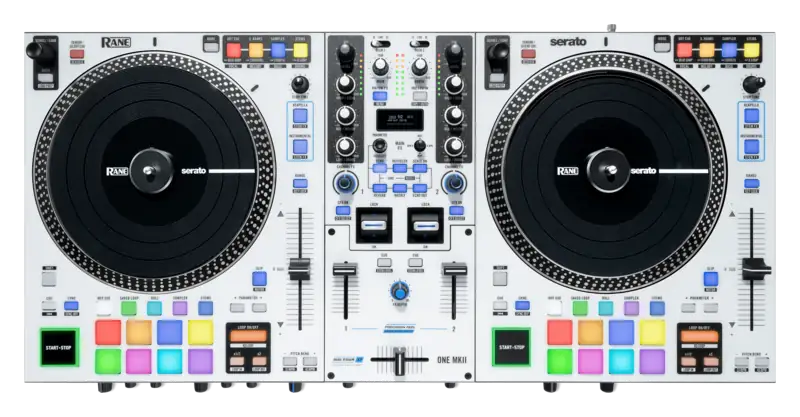
Two-channel Serato controller with 7.2-inch motorized platters, internal effects, dedicated Stems controls, dual computer connections, and professional outputs.
- Convincing motorized platter feel in a single controller.
- Useful Stems workflow and a large set of internal effects.
- Dual USB connections and strong professional audio connections.
- Only two mixer channels and two software decks.
- Heavy for a controller of this width.
- Costs much more than a non-motorized two-channel controller.
| Type | Two-channel motorized software DJ controller |
| Deck Control | Two decks |
| Platters | 2 x 7.2-inch motorized aluminum platters |
| Performance Pads | Eight pads per deck |
| Software | Serato DJ Pro; VirtualDJ and djay Pro with separate licenses |
| Hardware FX | 29 internal effects with paddle controls |
| External Inputs | 2 x phono/line RCA + 1 x auxiliary RCA |
| Microphone Inputs | 2 x XLR/TRS combo |
| Main Outputs | XLR stereo pair + RCA stereo pair |
| Booth / Zone Output | XLR stereo pair |
| Computer Connections | 2 x USB-B |
| Dimensions | 674.0 x 345.0 x 124.3 mm / 26.54 x 13.58 x 4.89 in |
| Weight | 11.14 kg / 24.56 lb |
The Rane ONE MKII is the direct choice for scratch and open-format DJs who want rotating platters but are happy to work from a laptop. Its 7.2-inch platters have adjustable torque, removable acrylic discs, and a proper spindle. They give you a much closer turntable-style response than a conventional jog wheel. The main sacrifice here is the ONE MKII only having two mixer channels.
The MKII update adds the parts that now matter in a Serato performance setup: internal Main FX, Fader FX, Stems FX, and a Stems Level mode that can turn the channel EQ controls into stem level controls. The controller also keeps the original Rane ONE’s dual computer connections, external deck inputs, two microphone inputs, and built-in power supply.
Two channels are the hard limit. The Rane Performer is the logical next step if you want four-deck control, a four-channel mixer, and motorized platters. If the laptop itself is the part you want to remove, the Rane System One brings the same basic platter idea into a standalone Engine DJ system. And that’s pretty much it.
You can learn more about different DJ controller layouts here: What Is A Battle Style DJ Controller Layout?
6. Denon DJ Prime 4+ – Best Standalone Value
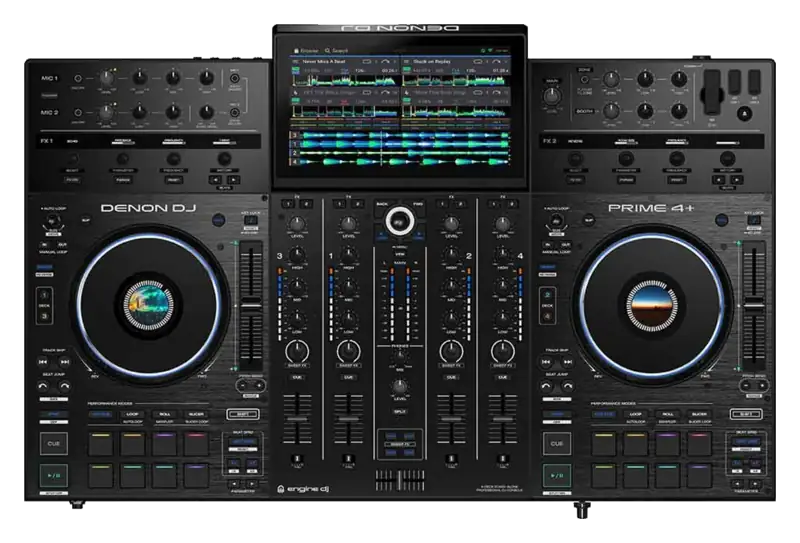
Four-deck standalone Engine DJ system with a 10.1-inch touchscreen, Wi-Fi streaming, internal drive bay, extensive media support, and external deck inputs.
- Four-deck standalone mixing with a responsive 10.1-inch screen.
- Excellent storage, media, streaming, and external input options.
- Strong feature set for mobile and event DJs.
- Six-inch jog wheels feel small beside full-size club platters.
- Engine DJ is a different workflow from common club Rekordbox setups.
- Large enough to require a proper case and transport plan.
| Type | Four-channel standalone DJ system |
| Standalone Decks | Four |
| Jog Wheels | 2 x 6-inch capacitive jog wheels with displays |
| Screen | 10.1-inch multi-touch display |
| Software / OS | Engine DJ; Serato DJ Pro unlock; VirtualDJ with separate license |
| Media | USB drives, SD card, Wi-Fi streaming, optional internal 2.5-inch SATA drive |
| External Inputs | 2 x phono/line RCA + 2 x line RCA |
| Microphone Inputs | 2 x XLR/TRS combo |
| Main Outputs | XLR stereo pair + RCA stereo pair |
| Booth / Zone Outputs | Separate XLR stereo pairs |
| Dimensions | 728.5 x 497.1 x 103.6 mm / 28.68 x 19.57 x 4.08 in |
| Weight | 9.68 kg / 21.34 lb |
The Prime 4+ remains one of the strongest standalone values near its price, even after the arrival of the newer PRIME 4 G2. It can mix four internal decks, analyze tracks on the unit, stream from supported services over Wi-Fi, read USB drives and SD cards, and take an internal 2.5-inch drive. Mobile DJs can also route a separate Zone output to another room.
The four-channel mixer accepts external line sources and two turntables, while Serato DJ Pro support gives you a laptop option when you need it. Engine DJ’s regular feature updates and the large touchscreen make the unit quick to use without a computer.
The six-inch jog wheels are one tradeoff here. They work well, but they do not give you the scale or feel of an XDJ-AZ or a pair of full-size club players. DJs whose main goal is to practice for Pioneer DJ and AlphaTheta club booths should look at the XDJ-AZ. Overall, it’s a very good pick if you don’t mind the Engine DJ ecosystem.
7. AlphaTheta XDJ-AZ – Best Club-Style Standalone System
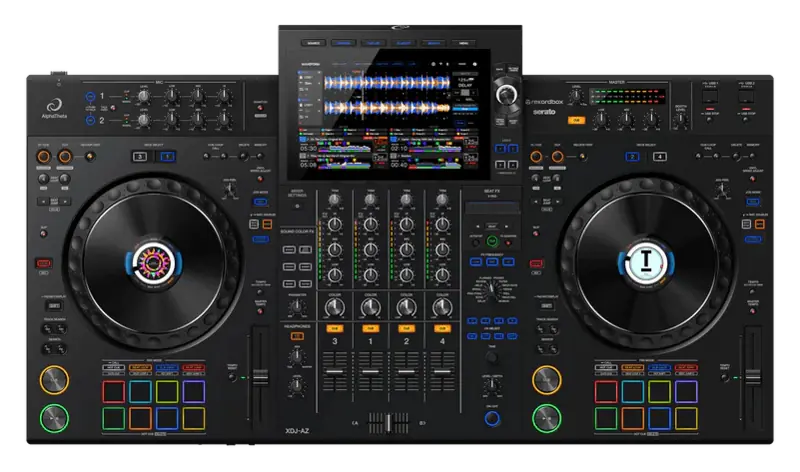
Four-deck standalone system with full-size mechanical jog wheels, a 10.1-inch touchscreen, Pro DJ Link, club-style controls, and Rekordbox and Serato support.
- Full-size jog wheels and a current club-style layout.
- Four-deck standalone playback with a large touchscreen.
- Pro DJ Link and strong Rekordbox integration.
- One of the most expensive systems in this guide.
- Very wide, deep, and heavy once placed in a case.
- Overkill unless the club-style workflow is a real priority.
| Type | Four-channel standalone DJ system |
| Standalone Decks | Four |
| Jog Wheels | 206 mm full-size mechanical jog wheels with displays |
| Screen | 10.1-inch capacitive multi-touch display |
| Software | Rekordbox and Serato DJ Pro |
| Media / Network | 2 x USB-A, USB-C, Wi-Fi streaming, CloudDirectPlay, Pro DJ Link |
| External Inputs | 2 x phono/line RCA |
| Microphone Inputs | 2 x XLR/TRS combo |
| Master Outputs | XLR stereo pair + RCA stereo pair |
| Booth Output | 1/4-inch TRS stereo pair |
| Dimensions | 895.0 x 504.1 x 133.4 mm / 35.2 x 19.8 x 5.3 in |
| Weight | 13.5 kg / 29.8 lb |
The XDJ-AZ is the closest all-in-one route to a current Pioneer DJ/AlphaTheta club booth. Its layout follows the CDJ-3000 and DJM-A9 family, the jog wheels are full-size, the mixer handles four standalone decks, and Pro DJ Link lets you add compatible players later.
The 10.1-inch touchscreen is a major improvement over older XDJ systems, and current standalone features include library access from USB media, CloudDirectPlay, and supported streaming services. Rekordbox and Serato DJ Pro support also let the XDJ-AZ work as a computer-based system when needed.
Size and price are the main reasons it sits below the Prime 4+ in this lineup. The XDJ-AZ makes sense when full-size controls, Rekordbox preparation, and club familiarity are worth paying for. The Prime 4+ grants you more storage and routing flexibility for less. On the other hand, the newer two-channel XDJ-AN is another current option if you want the AlphaTheta standalone workflow in a much smaller system.
8. Rane System One – Best Motorized Standalone System
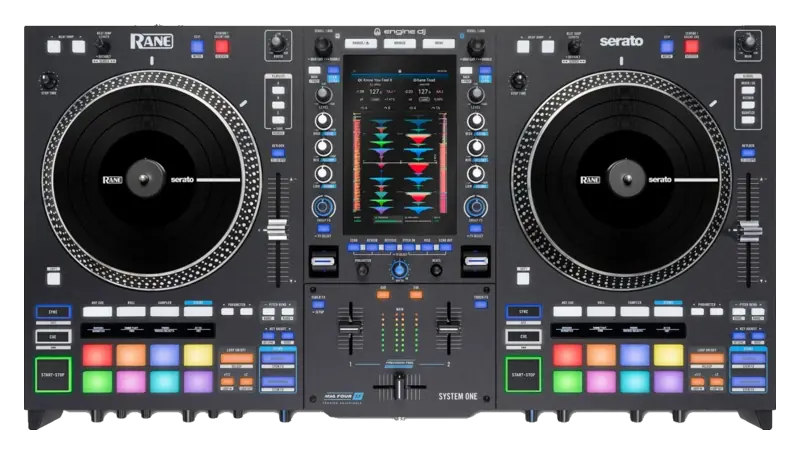
Two-channel standalone Engine DJ system with 7.2-inch motorized platters, a 7-inch touchscreen, extensive media support, internal effects, and Serato DJ Pro integration.
- Motorized platters without needing a laptop.
- Flexible Engine DJ media, storage, streaming, and Stems workflow.
- Can also unlock Serato DJ Pro for laptop use.
- Limited to two mixer channels and two active decks.
- No phono or line inputs for external decks.
- Very heavy and expensive for a two-channel system.
| Type | Two-channel motorized standalone DJ system |
| Standalone Decks | Two |
| Platters | 2 x 7.2-inch motorized aluminum platters |
| Screen | 7-inch HD multi-touch display |
| Software / OS | Engine DJ; Serato DJ Pro 4.0.3 or later |
| Media | 3 x USB-A, USB-C media input, SD card, Wi-Fi streaming, optional internal 2.5-inch SATA drive |
| External Audio Input | 1 x auxiliary RCA / Bluetooth input |
| Microphone Inputs | 2 x XLR/TRS combo |
| Main Outputs | XLR stereo pair + RCA stereo pair |
| Booth Output | 1/4-inch TRS stereo pair |
| Dimensions | 736.6 x 403.1 x 144.8 mm / 29.0 x 15.87 x 5.70 in |
| Weight | 13.33 kg / 29.4 lb |
The Rane System One fills a gap that existed for years on the market, that is, a professional standalone system with proper motorized platters. It runs Engine DJ on the built-in touchscreen, so you can mix from USB drives, an SD card, an optional internal drive, or supported streaming services without opening a laptop.
The performance side is much closer to the Rane ONE MKII than to a conventional standalone controller. You get 7.2-inch platters, a MAG FOUR crossfader, paddle-controlled internal effects, Stems controls, and hardware once again designed around scratch and open-format DJing. Serato DJ Pro support gives you a second workflow when a computer makes more sense, which is always nice to have.
There are only two decks here, with two mixer channels, and no switchable line/phono deck inputs for adding external players or turntables. It is also about as heavy as the XDJ-AZ. The System One earns its place for DJs who specifically want motorized standalone playback. If you absolutely need four channels on hand, the Prime 4+ and XDJ-AZ can be much more flexible choices for conventional four-deck mixing.
Some Food For Thought – Questions You Might Have
Should You Buy a Laptop Controller or a Standalone System?
A laptop controller gives you more software choice and usually more hardware for the money. It also means carrying, powering, and positioning a computer at every set (which depending on the place/venue can be more or less difficult). A standalone system costs more, but the screen, operating system, library, and playback hardware are built in. With a standalone device there also is one less step between you just going about your day and jumping into the mix in the “bedroom DJ” context if you already have your sound system plugged in. Just another thing to keep in mind.
Do You Need Four Channels?
Most new DJs do not necessarily “need” four mixer channels, but it’s a nice thing to have on hand regardless. Two channels cover standard transitions, scratching, loops, samples, and normal open-format work. Four channels are on the other hand very useful when you regularly layer extra tracks, route separated stems to their own channels, connect external players, or need more flexible handovers. Playing additional audio sources without disrupting your mix is one of the best perks I can think of here if you don’t do full 4-channel mixes often.
Should You Choose Rekordbox, Serato, or Engine DJ?
Rekordbox makes sense if you want to prepare USB drives for Pioneer DJ and AlphaTheta club gear. Serato DJ Pro is great for scratch, battle, and open-format performance controllers. If you don’t know what that means, I really think you should try both, which is perfectly possible with some of the devices listed above that work with both Serato and Rekordbox. Engine DJ is the standalone platform used by the Prime 4+ and System One, which places those devices in another category here.
Are Motorized Platters Worth The Extra Cost?
They are worth it if platter movement is part of how you cue, scratch, brake, and control a track. They also add weight, power requirements, cost, and moving parts that can wear out or become damaged over time. If you have no prior experience with scratching or using any vinyl/DVS systems, there is no harm in trying out a DJ controller with motorized platters at your local DJ store. I, however, wouldn’t necessarily force myself to get one if it’s not something you were thinking of initially, for instance, if you don’t think you’ll put much emphasis on scratching in your upcoming routines.
What Connections Matter for Paid Gigs?
Balanced XLR or 1/4-inch TRS master outputs, a separate booth output, two microphone inputs, and dual computer connections are the most useful upgrades for event work. External line or phono inputs matter if you plan to add turntables or media players. You can see the rest of a basic working setup in our DJ equipment guide, but in general in many cases you will be able to make do with even the simplest controllers when not limited by the inputs on the venue side. Still, the more you play, the more you start to appreciate the flexibility of having more outputs to choose from.
Which DJ Controller Should You Buy? – My “Quick & Dirty” Conclusion
Get the DDJ-FLX4 if you’re just starting out, you have no idea whether or not you’ll enjoy this whole “DJing” thing, and you want to start on a budget. Get the DDJ-GRV6 if you already know the basics and want the best balance of size, controls, software support, and price.
Then, I’d pick the DDJ-FLX10 for a complete professional Rekordbox or Serato laptop setup, if you want a DJ controller that you won’t be able to outgrow fast. It’s a perfect pick if you have the money and you want to “skip” the entry-level tier altogether. The Rane FOUR is a great pick for four-channel Serato performance, and the Rane ONE MKII can also be neat when motorized platters matter more than extra channels.
For standalone use, the Prime 4+ gives you the most practical features for the money, at least compared to the other options we have here. The XDJ-AZ is the better investment for a full-size club-style workflow. The Rane System One is the specialist choice for DJs who want both motorized platters and standalone playback. And that’s pretty much it!