
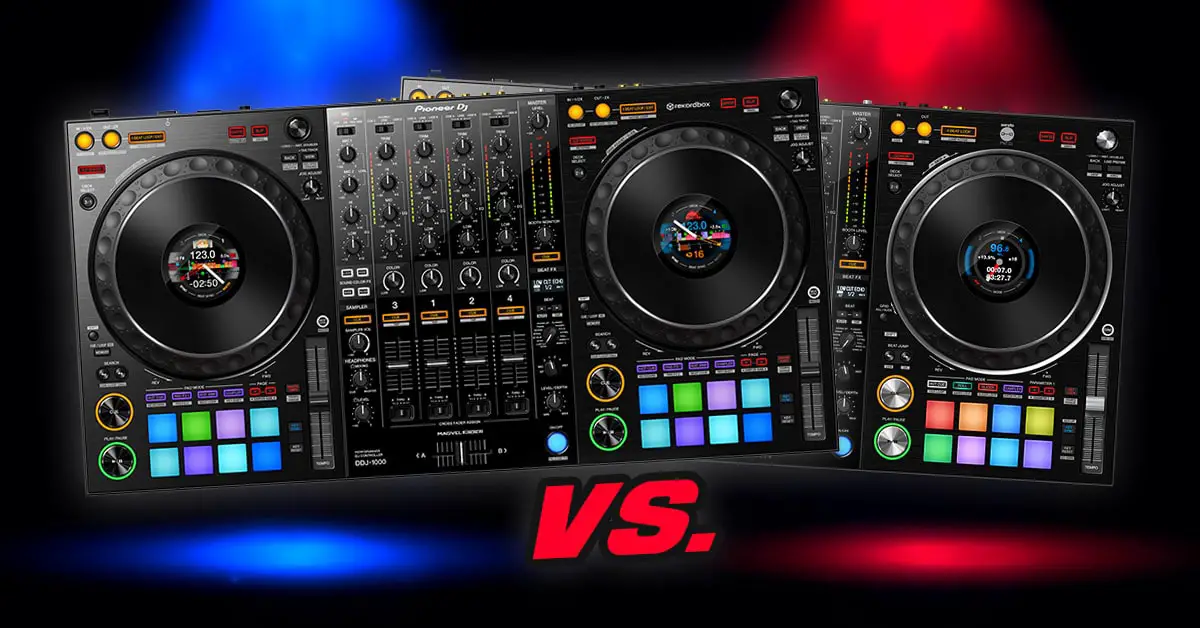
Pioneer DDJ-1000SRT vs. DDJ-1000 – what are the actual differences? Both are now older 4-channel controllers, with the DDJ-1000 officially discontinued and the DDJ-1000SRT archived. If you’re choosing between them on the used market, the software ecosystem is still the biggest difference – just not the only one. The newer DDJ-FLX10 effectively removes this old Rekordbox vs. Serato split by supporting both platforms on one updated controller.
This web portal is reader-supported and is part of the AliExpress Partner Program, Amazon Services LLC Associates Program, eBay Partner Network, and Guitar Center Affiliate Program. When you buy using links on our site, we may earn an affiliate commission.
Pioneer DDJ-1000 vs. Pioneer DDJ-1000SRT – full specification comparison
| Specs |
|---|
DDJ-1000 vs. DDJ-1000SRT – the main difference
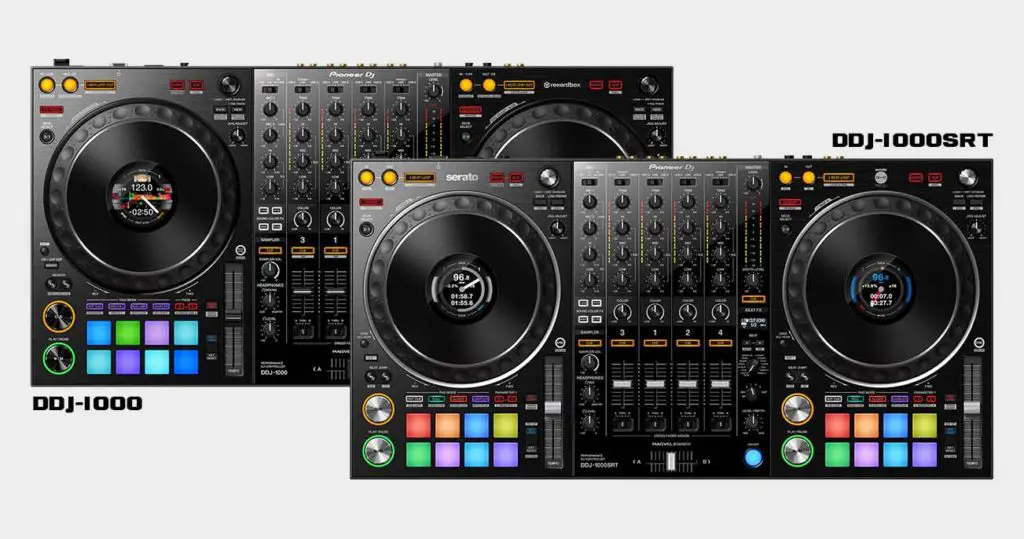
The main difference is the software platform each controller was designed around. The DDJ-1000 is the Rekordbox version, while the DDJ-1000SRT is the Serato DJ Pro version.
You can skip to the Software compatibility section down below for more details on that.
What else is different on the DDJ-1000SRT?
The DDJ-1000SRT keeps almost the same overall layout as the original DDJ-1000, but Pioneer made a few visual and functional changes to adapt it to Serato.
While much of the original functionality of the Pioneer DDJ-1000 remains unchanged on the DDJ-1000SRT, there are some important differences between the two.
The easiest visual difference to spot is the silver finish used on parts of the DDJ-1000SRT, including the faders, several controls and the jog wheel edges.
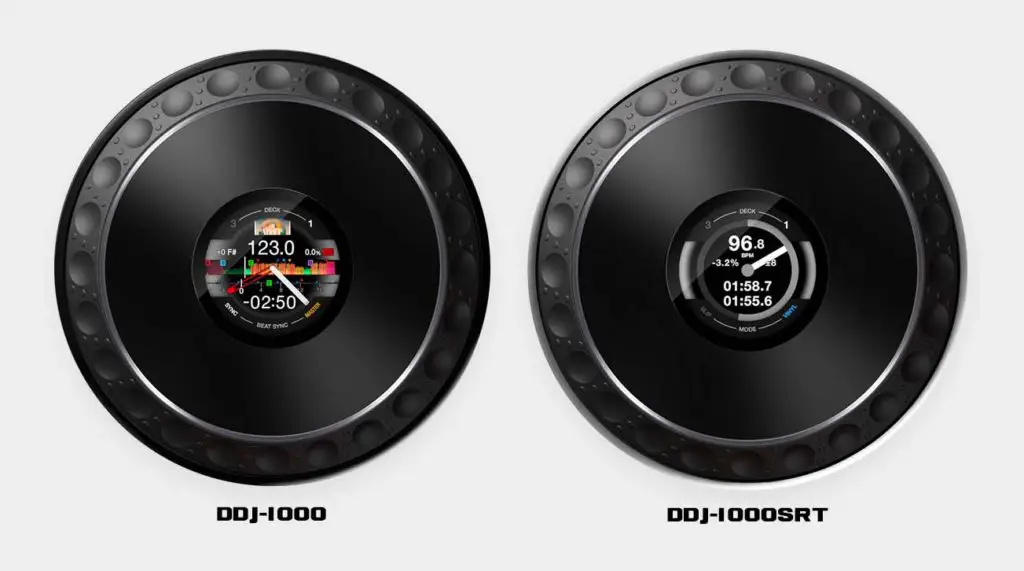
The jog displays also work differently. The DDJ-1000 can display track waveforms and more detailed Rekordbox information, while the DDJ-1000SRT uses a simpler Serato-style layout without waveform display.
The performance pad mappings are another noticeable difference. The DDJ-1000 follows Rekordbox with modes such as Pad FX, Beat Jump, Beat Loop and Key Shift, while the DDJ-1000SRT uses Serato-oriented modes including Roll, Slicer, Cue Loop, Saved Loop and Pitch Play.
The DDJ-1000SRT can also use its performance pads for Serato Stems by replacing one of the supported primary pad modes.
| Pioneer DDJ-1000 on Ebay: |
The FX sections
Both the Pioneer DDJ-1000 and the Pioneer DDJ-1000SRT make use of their in-built Pioneer hardware FX, pretty much the same ones you can find on the Pioneer DJM-900NXS2 mixers.
These effects will work even when the device is on in standalone mode.
On the DDJ-1000SRT, the dedicated mixer FX controls operate the controller’s built-in Beat FX and Sound Color FX rather than Serato’s software DJ-FX. You can still use Serato’s software effects from the software itself or through additional mapping, but there aren’t dedicated hardware controls for them.
If modern software FX, Stems controls and support for both Serato and Rekordbox matter to you, the newer DDJ-FLX10 is the more obvious upgrade.
Loop controls on the DDJ-1000SRT
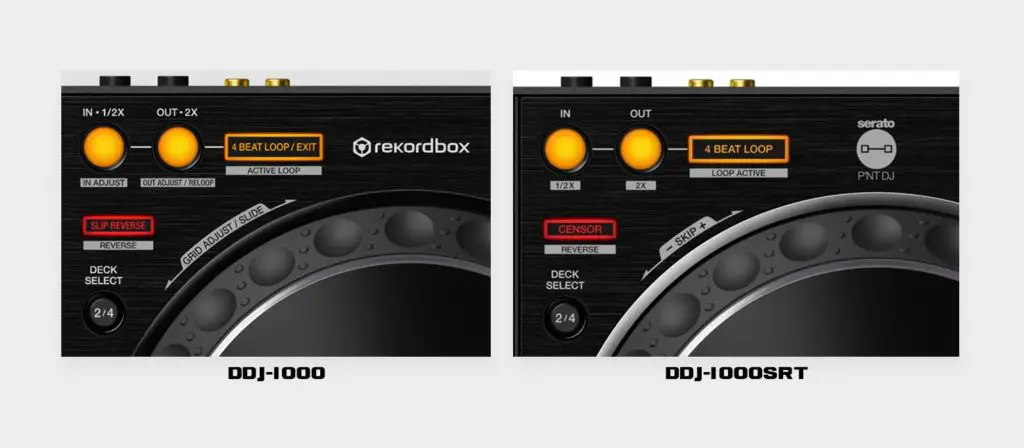
The DDJ-1000SRT keeps essentially the same physical loop-control layout as the DDJ-1000, although the labels and secondary functions are adapted to Serato.
The controls work natively for setting manual loops, activating a 4-beat loop and changing the loop length. You can remap controls if you prefer a different workflow, but it isn’t required for normal looping.
Can the DDJ-1000SRT work with Rekordbox?
Can you officially use the DDJ-1000SRT with Rekordbox? Sadly, no. Here is the important thing – you cannot use your DDJ-1000SRT with Rekordbox DJ software, just as you cannot use your original DDJ-1000 with Serato DJ Pro.
Software compatibility
The DDJ-1000 is still listed as a Rekordbox Hardware Unlock device. Connecting it lets you control Rekordbox Performance mode without subscribing to a paid plan.
The DDJ-1000SRT works the other way around: connecting it unlocks Serato DJ Pro without requiring a separate DJ Pro license.
If the controller choice is really coming down to the software, I’ve compared Rekordbox and Serato separately here.
Both controllers are also MIDI-compatible and can be used with other software through appropriate mappings. The DDJ-1000 has official VirtualDJ support, and VirtualDJ also supports the DDJ-1000SRT.
New DDJ-1000SRT units originally included a Serato Pitch ‘n Time DJ voucher. If you’re buying one used today, don’t assume that code is still included or included and unused.
Both can also be used in DVS setups, but the licensing is different. The DDJ-1000 requires the appropriate Rekordbox plan for DVS, while the DDJ-1000SRT requires Serato DVS functionality in addition to its base Serato DJ Pro hardware unlock.
If you’re not familiar with that kind of setup, I’ve also covered and explained DVS and timecode systems here.
Inputs and outputs and standalone mixers
Pioneer DDJ-1000 and Pioneer DDJ-1000SRT feature the same audio inputs and outputs. The mixers of both these devices are also able to work in standalone mode.
This means you can use the mixer sections without a computer connected, as long as the controller itself is powered. External players or turntables can still be mixed and processed with the built-in hardware FX.
This is mixer-only standalone operation – the controller decks themselves cannot play tracks without DJ software.
Inputs and outputs on the DDJ-1000/SRT:
| Inputs | – 2x LINE (RCA) – 2x PHONO/LINE (RCA) – 2x MIC (XLR & 1/4 inch TRS Jack) |
|---|---|
| USB | – 2x USB B ports |
| Outputs | – 2x MASTER (XLR, RCA) – 1x BOOTH (1/4 inch TRS jack) – 2x PHONES (1/4-inch stereo jack, 1/8 inch stereo jack) |
Main differences between the Pioneer DDJ-1000 and the DDJ-1000SRT
To sum it all up, here are the main differences between the DDJ-1000 and the DDJ-1000SRT:
- DDJ-1000 is designed around Rekordbox; DDJ-1000SRT is designed around Serato DJ Pro.
- DDJ-1000 is a Rekordbox Hardware Unlock device; DDJ-1000SRT unlocks Serato DJ Pro.
- Neither model officially supports the other’s main software platform.
- DDJ-1000 can display track waveforms in its jog screens; DDJ-1000SRT cannot.
- Their performance-pad modes differ because of the Rekordbox and Serato workflows.
- DDJ-1000SRT uses silver accents on several controls and around the jog wheels.
The conclusion – which one is better for you?
If you’re choosing between these two today, the software you want to use is still the first thing I’d look at. For Rekordbox, the original DDJ-1000 is the obvious choice. If you’re committed to Serato DJ Pro, the DDJ-1000SRT gives you essentially the same club-style hardware built around Serato instead.
There are a few differences beyond that – mainly the jog displays, performance pad mappings, key controls and some smaller labeling changes – but mechanically these controllers are extremely close.
The bigger question today is whether either one is cheap enough to make sense used. The DDJ-FLX10 replaced this split with one controller that works with both Rekordbox and Serato DJ Pro, adds dedicated Stem controls and has much longer support life ahead of it. If the used price of a DDJ-1000 or 1000SRT gets too close to the FLX10, I’d go with the newer controller.