

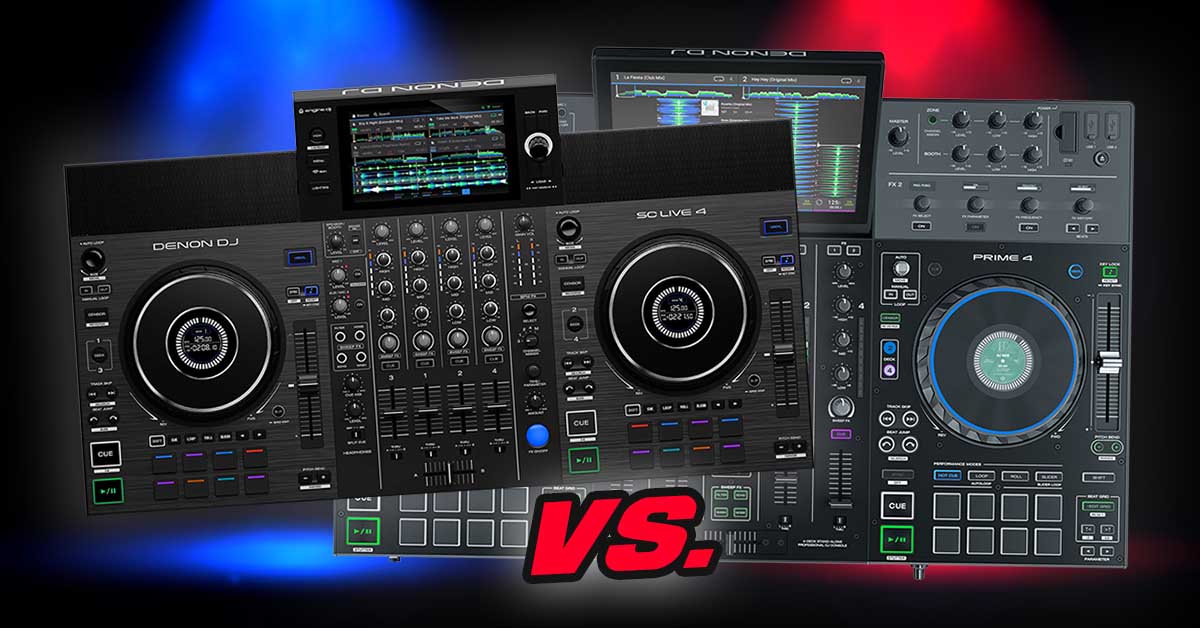
Denon DJ Prime 4 vs. Denon DJ SC Live 4 – which one is better for you? The Prime 4 gives you the larger screen, internal drive bay, Zone Output and more flexible I/O, while the SC Live 4 is much lighter and adds built-in speakers. Here I’ll go over the most important differences and similarities between the two, plus a few alternatives such as the SC Live 2, XDJ-RX3 and Numark Mixstream Pro.
Note: This comparison is specifically about the older, original Denon DJ Prime 4, not the newer Prime 4+ or Prime 4 G2.
This web portal is reader-supported and is part of the AliExpress Partner Program, Amazon Services LLC Associates Program, eBay Partner Network, and Guitar Center Affiliate Program. When you buy using links on our site, we may earn an affiliate commission.
Denon DJ SC LIVE 4 vs. Denon DJ PRIME 4 – full specification comparison
| Specs |
|---|
General comparison
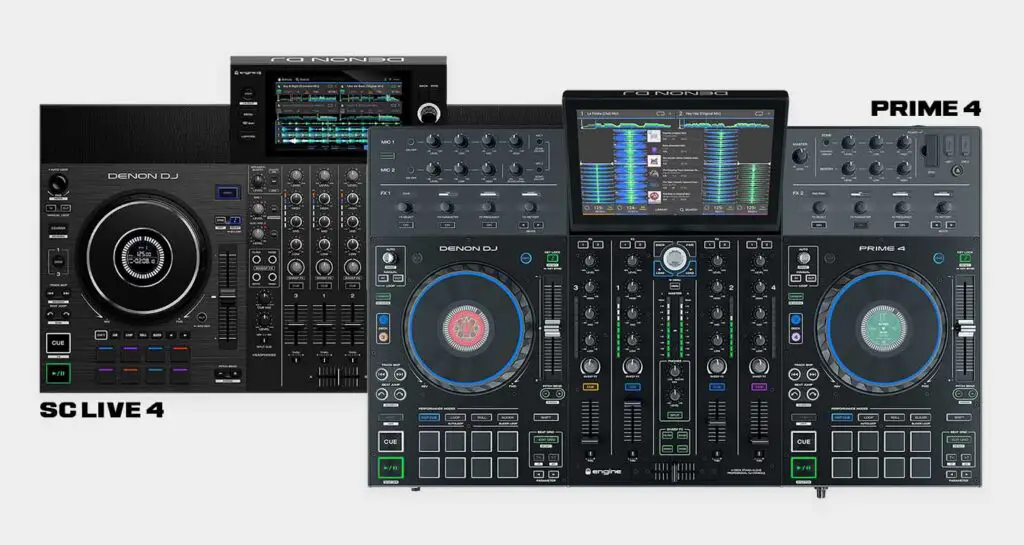
To start off, the SC Live 4 is a lighter and more compact 4-channel standalone system, while the original Prime 4 gives you a larger screen, internal drive bay, Zone Output and more extensive connections.
The SC Live 4 takes a slightly different approach rather than simply being a stripped-down Prime 4, most notably with its built-in speakers and different FX layout.
The Prime 4 handles audio FX in a slightly different way, is more bulky than the SC Live 4 and it offers you a layout that’s similar yet still quite a bit different from the one on the Live 4. It also doesn’t have the built in speakers you can find on the SC Live 4.
Denon DJ Prime 4 has a bigger touch display, supports additional deck controllers such as the LC6000, offers DVS support with Serato DJ Pro, and in general feels much sturdier than the SC Live 4.
The Denon DJ Prime 4 weighs around 21.34 lbs (9.7 kg), while the Denon DJ SC Live 4 weighs around 12.8 lbs (5.8 kg). Also a notable difference.
Other than that, the Prime 4 also features a Zone Output (an audio output independent of the sound output from the main decks) and an in-built drive bay for internal track storage.
I’ve also compared the Prime 4 directly with the Pioneer XDJ-XZ if you’re considering both ecosystems on these older devices.
Now let’s take an even closer look at each of the most important differences and similarities between the Denon DJ SC Live 4 and the Denon DJ Prime 4.
The screen – touch displays
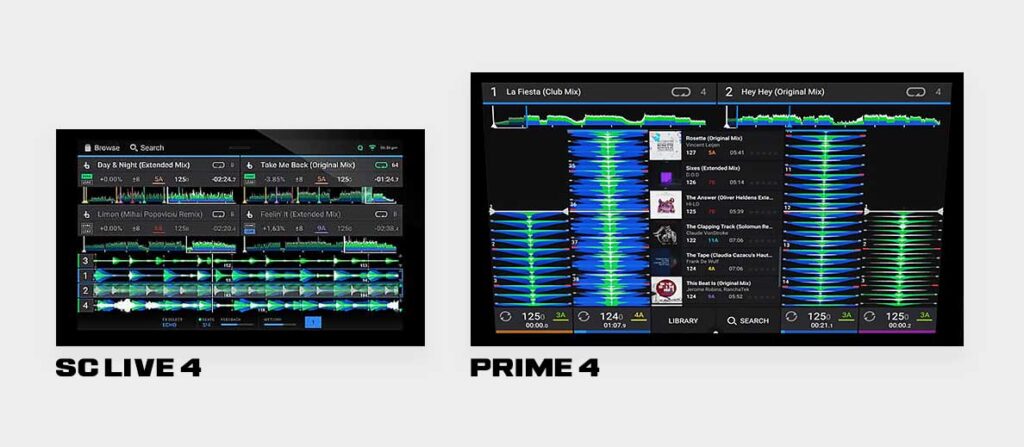
The Denon DJ Prime 4 features a 10.1″ touch display, while the Denon DJ SC Live 4 makes use of a smaller 7″ touch screen.
Both devices utilize the same Engine OS, but navigating the system settings and track library is noticeably more comfortable on the larger Prime 4 display.
The screen on the SC Live 4 is also notably smaller than the one present on its rival on the Pioneer DJ side – the Pioneer XDJ-RX3 (also a 10.1″ touch display).
Jog wheels
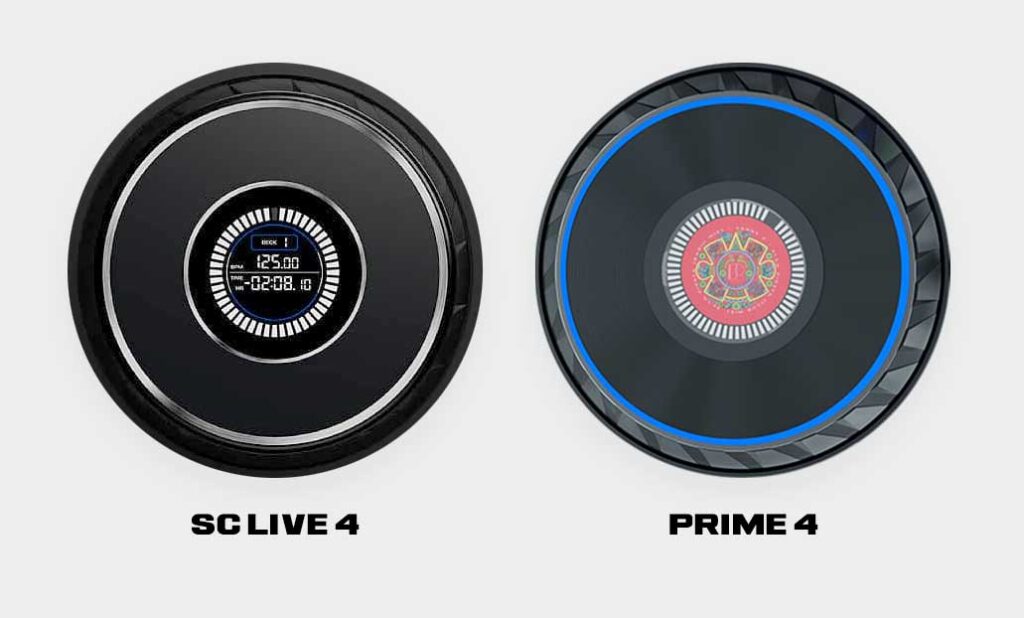
Denon DJ Prime 4 features two 6″ jog wheels with built in displays, and the Denon DJ SC Live jog wheels are the exact same size.
Just like on the Prime 4, you won’t find any kind of mechanical tension adjustment knob or setting on the Denon DJ SC Live 4.
The SC Live 4 screens are able to display additional track information on its jog wheel displays such as the track tempo, deck number and the elapsed time of the currently playing song.
Performance pads
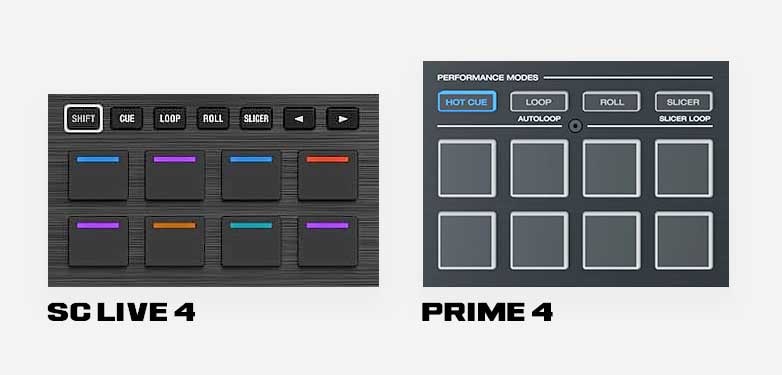
The performance pads on both devices cover the same core modes and differ mostly when it comes to their design. Both also support Sampler mode and pre-rendered Engine Stems. The pads on the SC Live and Prime 4 also both feature RGB backlight.
On the Denon SC Live 4, the Shift button and pad mode controls sit above the performance pads, while the RGB backlight is visible as narrow strips along the top of each pad.
The Denon DJ Prime 4 has full pad edge backlight and its shift button is positioned in a more convenient place (on the right side of the performance pads on each deck).
Audio FX
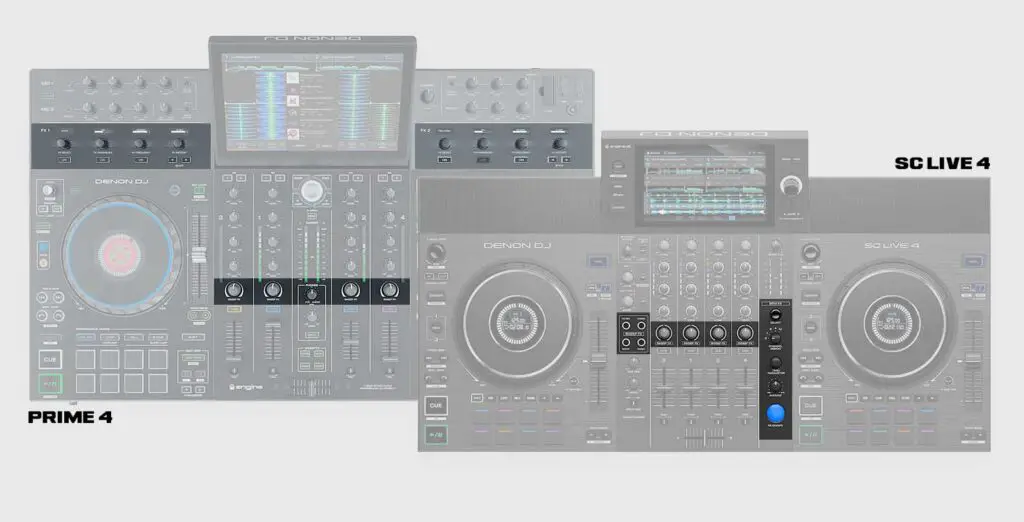
Denon DJ Prime 4 goes with an FX control scheme that’s quite similar to the traditional way Serato DJ controllers went about it in the past, for example the DDJ-SX series.
There are two effect sections, one for each deck, and they consist of FX select, FX parameter, FX frequency and FX wet/dry knobs. Above the knobs there are small displays that will show you what audio effect is currently chosen and what is the current state of the set FX parameters.
Aside from these 2 FX sections, you have access to 4 sweep FX from the mixer section (Filter, echo, wash & noise).
On the Prime 4 you can activate up to 3 audio FX at one time – 2 from the 2 main FX sections, and one from the Sweep FX section.
Denon DJ SC Live 4, has its FX section modeled after DJM mixer FX controls, in a similar way to the Pioneer XDJ-RX3. You can activate up to 2 audio FX at one time (one Sweep FX effect and one effect from the main FX section).
The important advantage that the Prime 4 has here, is that it features two independent FX sections that you can assign to each and every of its 4 mixer channels.
On the SC Live 4, you can only assign the main FX section to one channel at a time.
Note: Both devices also have touchscreen-based Touch FX in Engine OS, which can be assigned to any channel (like the Wash Out FX which is a Denon take on the Echo Out FX known from Pioneer DJ devices).
| Denon DJ SC Live 2 on Ebay: |
| Denon DJ SC Live 4 on Ebay: |
| Denon DJ Prime 4 on Ebay: |
Streaming services access
As the Denon DJ SC Live 4 features a wi-fi module and it can support wireless network connections, you can make use of quite a few music streaming services for sourcing your music.
Denon DJ SC Live 4 supports the following music streaming services:
- Amazon Music Unlimited
- Apple Music
- Beatport
- SoundCloud GO+
- TIDAL
- Dropbox (with your own uploaded tracks)
Amazon Music Unlimited and Apple Music are two notable advantages here, as neither is supported on the original Prime 4.
The original Denon DJ Prime 4 supports Beatport, SoundCloud GO+, TIDAL and Dropbox, but not Amazon Music Unlimited or Apple Music.
Built-in speakers
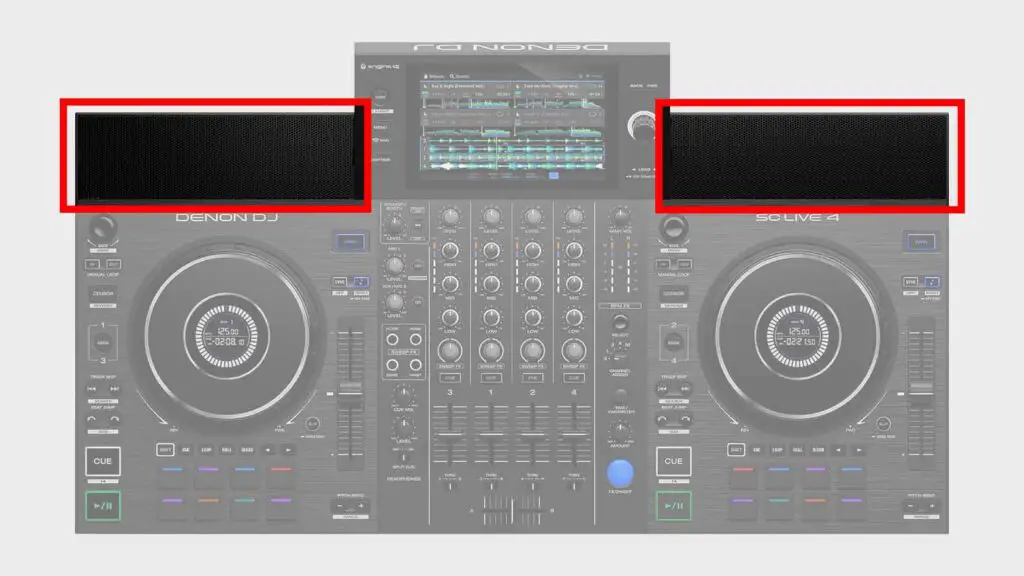
Denon DJ SC Live 4 has a set of 2 speakers. These are pretty loud and have a nice bassy tone to them. Don’t expect them to hold up in house party kind of situations though. When a few talking people are involved they might simply not be enough.
Overall, the speakers on the SC Live 4 are meant either for home practice, or for audio monitoring during your set. Yes, you can set the speakers to function as audio monitors, so that you don’t have to rely on your headphones all the time.
Can you disable the speakers on the Denon DJ SC Live 4? Yes, you can freely enable and disable the speakers, as well as control their volume using the speaker controls placed on the mixer section.
You might also like: Can You DJ Without Headphones? – And How To Do That
Software compatibility
The Denon DJ SC Live 4 is compatible with Serato DJ Pro and VirtualDJ if you wish to use it when connected to your laptop.
Denon DJ Prime 4 also supports Serato DJ Pro and VirtualDJ, so there are no notable differences here.
As with most pieces of Denon DJ gear, Traktor Pro is not officially supported by the hardware.
Denon DJ SC Live 2 vs. SC Live 4
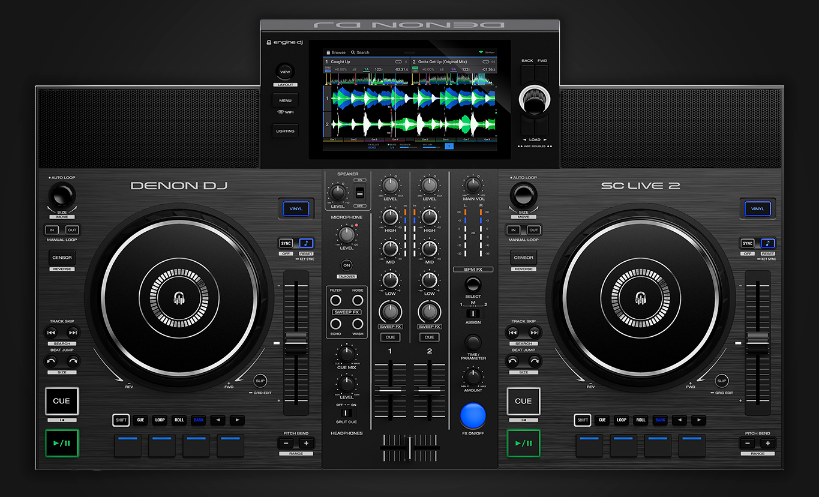
Denon DJ SC Live 2 is the stripped down 2 channel version of the SC Live 4.
Is the Denon DJ SC Live 2 worth it? Well, in my opinion, not quite. At this price point you could either go a little bit higher and get the full SC Live 4 experience or go lower and settle with the Numark Mixstream Pro which is very close to the SC Live 2 feature wise.
Unless you specifically want the smaller 2-channel layout, I’d usually go for the SC Live 4 for the extra I/O, jog displays and full 8-pad sections.
The Denon DJ SC Live 2 features no in-built jog displays, no booth outputs, no aux input, doesn’t have a second microphone input and has only 4 performance pads per deck.
Denon DJ SC Live 4 or the Pioneer XDJ-RX3?
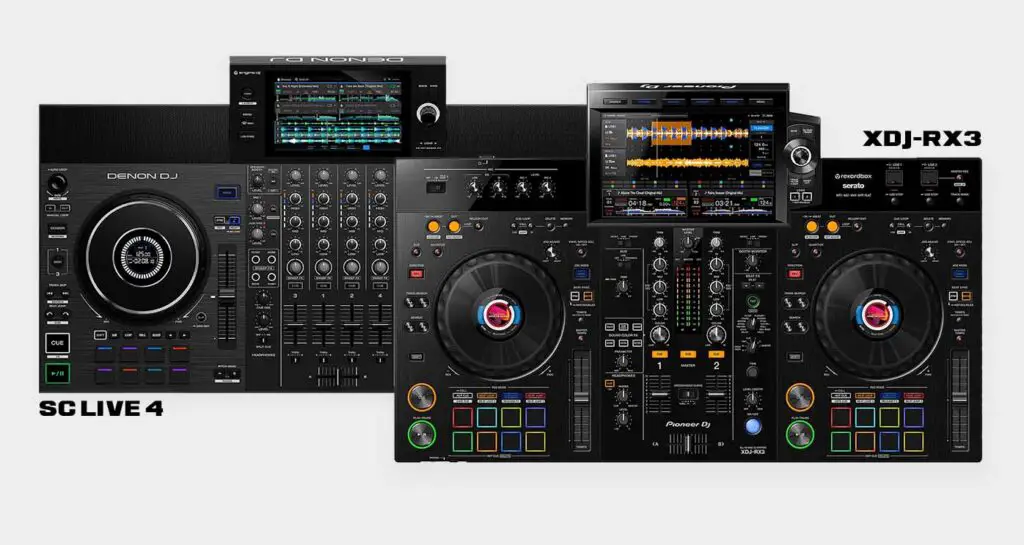
A device that’s definitely worth comparing with the Denon DJ SC Live 4 is the Pioneer XDJ-RX3 – a 2-channel standalone DJ system from Pioneer DJ.
When it comes to the places where the XDJ-RX3 is at a disadvantage, the lack of built-in wi-fi capabilities is a first thing. This of course means no support for any streaming services on the RX3.
Other than that, the RX3 features only 2 mixer channels and lacks all the additional features that the Denon DJ Engine OS software has to offer (such as the ability to control lighting – Philips Hue, Nanoleaf, and DMX systems).
Pioneer XDJ-RX3 is a great choice if you’re more used to (or prefer) the Pioneer DJ ecosystem. It will handle somewhat similar to a standard club setup and if you already used some of the Pioneer DJ players, mixers or professional DJ controllers, it might seem more familiar.
The Pioneer XDJ-RX3 also features a bigger touch display (7″ on the SC Live 4 vs. 10.1″ on the RX3). Keep in mind though, that the display on the RX3 is still a standard resistive type sceen incapable of supporting on-screen gestures or multitouch).
If I were to add something here, the FX implementation and the general variety of the available effects is much better on the RX3 with the traditional DJM mixer-based FX sections and access to the additional Pad FX mode.
Denon DJ SC Live 4 and the Numark Mixstream Pro
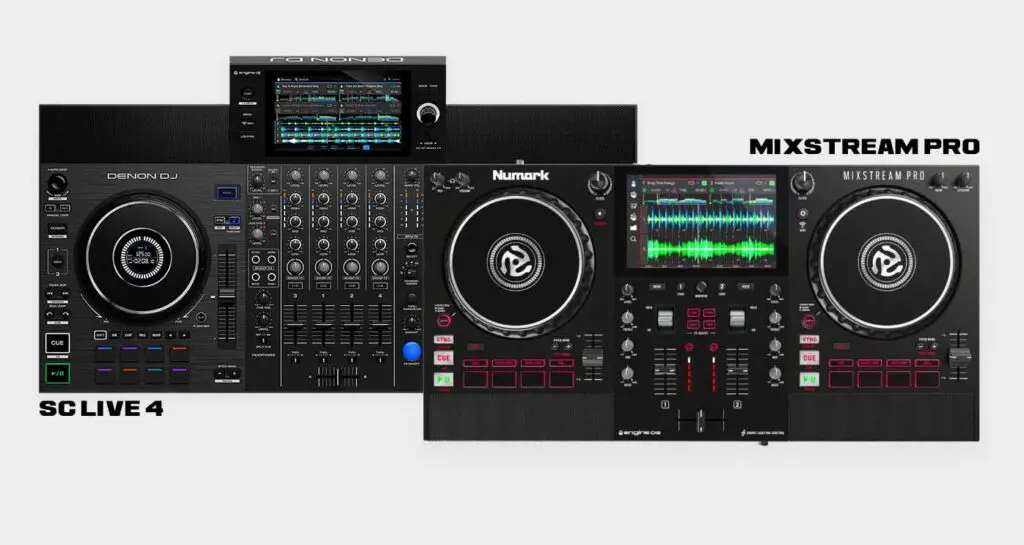
Another standalone DJ controller featuring built-in speakers is the previously mentioned Numark Mixstream Pro.
Mixstream Pro is a little bit more limited when it comes to its feature set when compared to the Denon DJ SC Live 4, and it has a pretty similar 7″ touch display on-board. It also makes use of the same Engine OS.
Other than that, 4 performance pads, only 2 mixer channels, no jog wheel displays and limited FX section place the Numark Mixstream Pro somewhat closer to the Denon DJ SC Live 2 – the cut-down version of the SC 4.
The conclusion
So, which one of these two would be better for you? If you want the larger 10.1-inch display, internal drive bay, Zone Output and more flexible connections, the original Denon DJ Prime 4 is the stronger option of these two.
The Denon DJ SC Live 4 is much lighter and adds a few interesting features such as the DJM-styled FX layout and built-in speakers. In the end, the choice between the two boils down to deciding which features are more important to you.